Wireless charging has become increasingly popular as a convenient way to power devices without the need for physical cables. One of the latest innovations in this field is magnetic wireless charging[^1], which uses magnets to align and secure devices during charging. This technology is most commonly seen in MagSafe chargers for iPhones but is expanding to other devices, including wearables and Android phones.
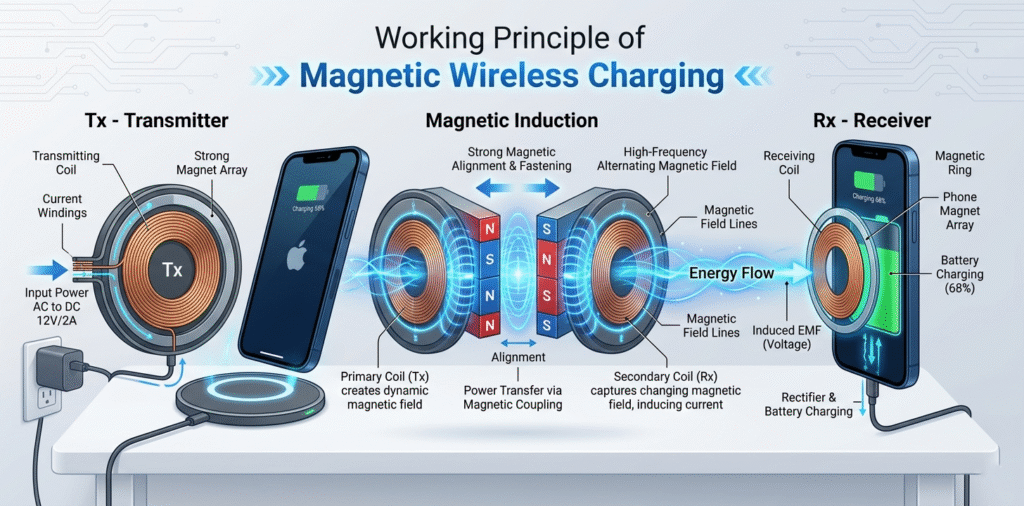
Magnetic wireless charging uses aligned magnets and inductive coils[^2] to transfer power without wires. Magnets ensure coil alignment while inductive coupling moves energy from transmitter to receiver.
So, how does magnetic wireless charging[^1] work? Let’s dive into the core principles, the role of magnets, and how to get the best performance from this charging technology.
How does wireless magnetic charging work?
I wanted a simple explanation I could remember.
Magnetic wireless charging combines a magnet array and inductive coils[^2]. The magnets align the transmitter and receiver. The coils use alternating current to create a magnetic field that induces current in the receiver coil. The phone’s electronics then convert that to DC to charge the battery.
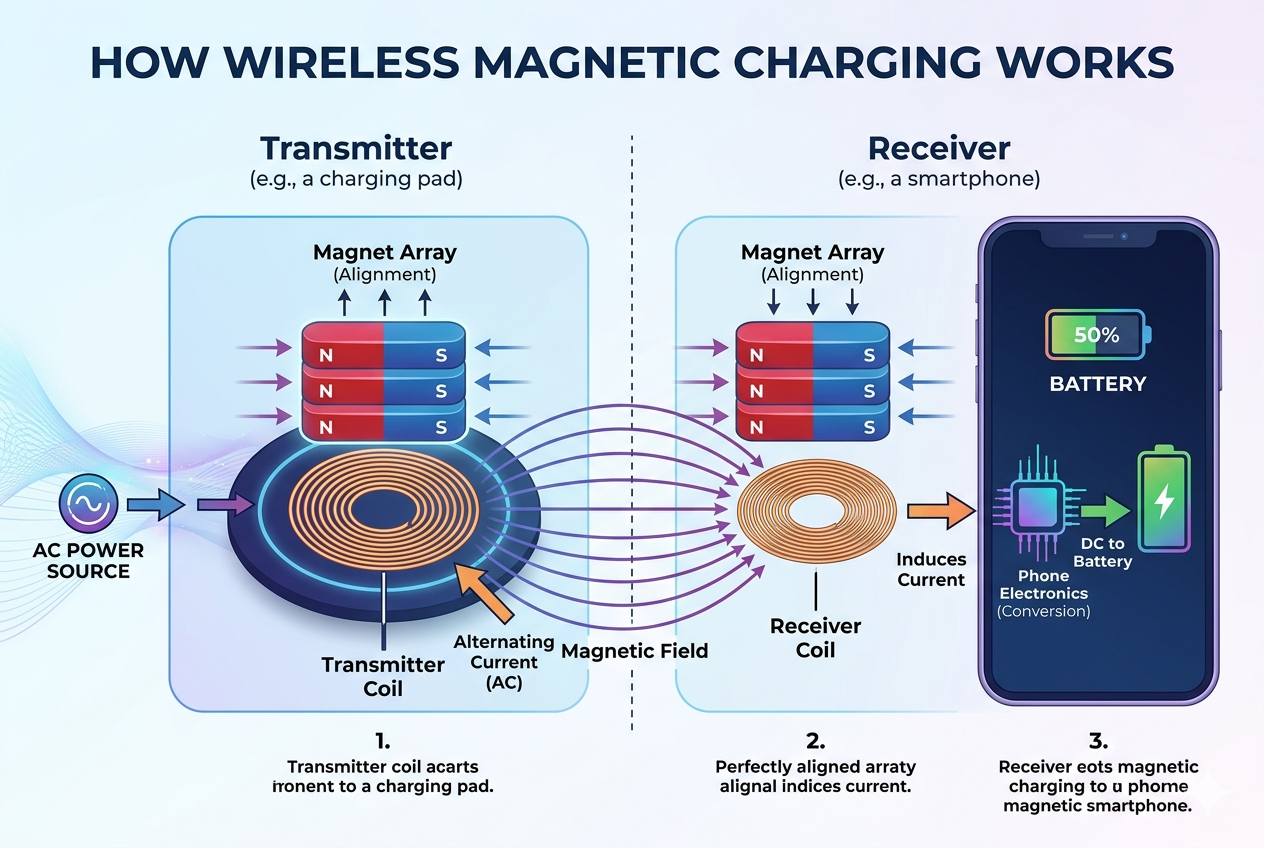
I opened a charger and saw the coil and magnets. That made the process clear.
coils, resonant coupling, magnet roles[^3], and power negotiation Inductive wireless charging works on Faraday’s law[^4]. An alternating current in the transmitter coil creates an oscillating magnetic field. When the receiver coil sits within that field, a voltage is induced in it. That voltage becomes alternating current in the receiver. The receiver circuitry then rectifies and regulates the power into DC for the battery. Magnetic wireless systems add a ring of magnets to guide alignment. Proper alignment increases coil coupling[^5] and reduces energy loss. Some systems use resonant coupling. They tune coils to the same frequency to improve efficiency over slightly larger gaps. Power delivery follows negotiation protocols like Qi. The transmitter and receiver exchange data over the magnetic field or a linked Bluetooth channel. They agree on voltage and current, monitor temperature, and stop charging when the battery is full. Good thermal management[^6], foreign object detection[^7], and certified components keep the system safe.
What is the principle of wireless charging?
I wanted deeper physics but in plain words.
The core principle is electromagnetic induction[^8]. A changing magnetic field creates an electric field in a nearby conductor. Wireless charging systems exploit this to move energy across a small gap without direct contacts.
I sketched the coils and the field lines to visualize how energy crosses the gap.
technical breakdown, efficiency factors, and system components Electromagnetic induction is the heart of wireless charging. The transmitter coil is driven by an AC source at tens or hundreds of kilohertz. This creates a changing magnetic flux. The receiver coil, placed nearby, intercepts part of the flux. Faraday’s law[^4] says the changing flux induces an electromotive force (EMF) in that coil. The induced EMF depends on coil turns, coil area, flux change rate, and alignment. Efficiency depends on coil coupling[^5] factor, coil quality (Q factor), distance, and alignment. Magnet arrays improve coupling by holding coils in the best position and by shielding stray fields. The system also requires rectifiers, voltage regulators, and communication circuits to manage power safely. Advanced designs use synchronous switching[^9] and resonance to boost efficiency. Foreign object detection adds safety by sensing metal that could overheat. Real-world efficiency ranges widely: good designs hit 70–90% under ideal alignment; poor alignment drops efficiency and raises waste heat.
Why do magnets improve wireless charging?
I wanted to know why magnets matter beyond aesthetics.
Magnets lock the transmitter and receiver into the best position. That maximizes coil overlap, raises coupling, and lowers energy loss. Magnets also help user experience by giving a clear physical snap.
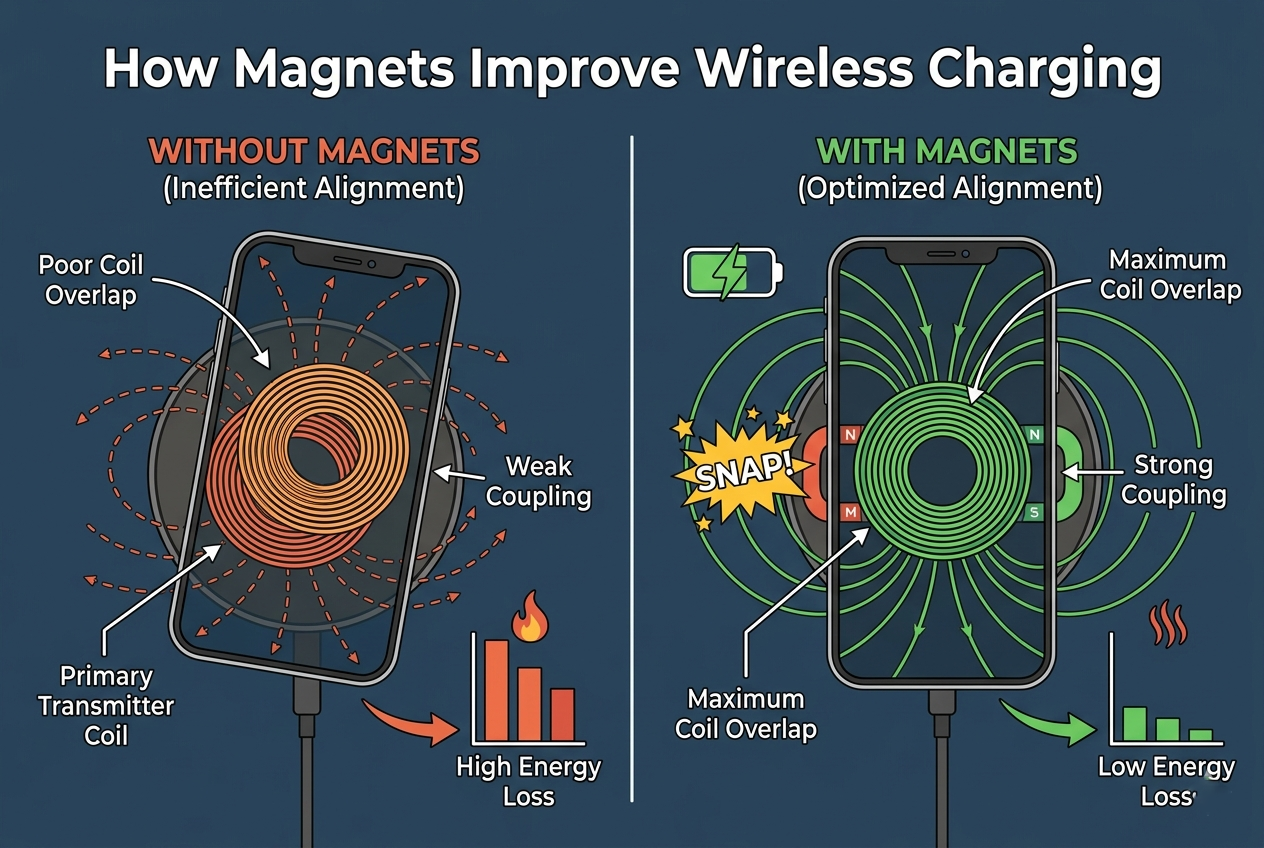
I tried a magnetic and a non-magnetic pad. The magnetic one charged faster and felt more reliable.
magnetic array designs[^10], coil placement, and real-world trade-offs Magnetic arrays vary by design. A simple ring of magnets centers the receiver over the transmitter coil. More advanced arrays match the phone’s internal coil geometry. By aligning coils precisely, magnets improve the mutual inductance between coils. Higher mutual inductance means more power transfers for the same input. That reduces wasted energy and heat. Magnets also limit lateral movement, which keeps the coupling stable when you pick up the phone to glance at the screen. The trade-offs include added weight and cost. Magnets can affect compass sensors and near-field communication depending on placement. Manufacturers balance magnet strength, size, and placement to avoid interference with other components. Some systems add magnetic shielding to protect nearby electronics. For accessories, compatibility matters. A magnetic array optimized for one phone model may not align well with another, reducing efficiency. That is why some third-party magnetic chargers include adjustable or larger magnetic patterns.
What limits wireless magnetic charging efficiency[^11]?
I expected losses but wanted specifics.
Losses come from misalignment, coil resistance[^12], core losses, distance, and heat. Materials, design, and thermal constraints all limit real-world efficiency[^13].
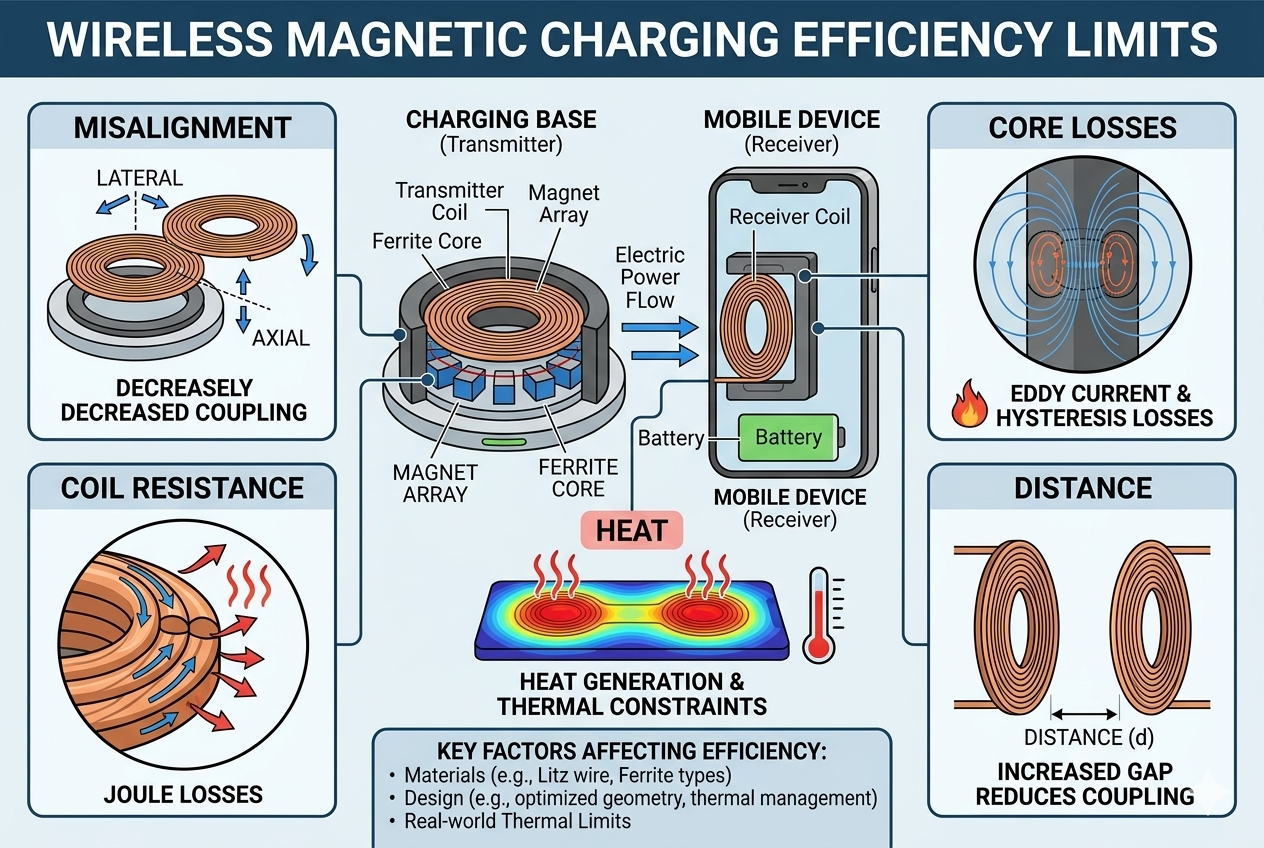
I measured temps and saw efficiency drop as alignment got worse.
practical factors: materials, distance, frequency, and safety mechanisms Coil resistance produces I^2R losses. Higher frequency reduces coil size but increases switching losses and skin effect. Core materials and coil geometry affect magnetic flux and losses. Greater distance between coils lowers coupling and pushes more energy into stray fields. Misalignment sharply reduces mutual inductance. Heat buildup forces the system to throttle power. Foreign object detection circuits can stop charging if they detect unexpected metal, reducing risks but interrupting power. Shielding and ferrite layers help focus flux and reduce eddy currents in nearby metal. Regulatory limits and safety standards cap transmitter power and emission levels. In practical use, heat management and user behavior matter. Thick cases, metal plates, or wallets between coils reduce efficiency. Design choices like using multiple transmitter coils or dynamic coil steering[^14] can improve real-world performance but add cost and complexity.
How can users get the best performance from magnetic wireless charging[^1]?
I wanted simple steps to improve charging.
Use certified chargers[^15], remove thick or metal cases, align the phone on the magnetic ring, avoid heavy use while charging, and keep the area cool.
I followed these tips and saw faster, cooler charges.
checklist, troubleshooting steps, and safe practices Start with a certified charger that follows Qi or the device maker’s magnetic standard. Inspect your case for metal or thick layers; remove them or use a thin MagSafe-compatible case[^16]. Place the phone on a flat hard surface and let the magnets snap it into position. If charging is slow, try removing the case and try again. Check the charger’s power rating and the phone’s supported wireless wattage. Use a quality USB-C PD power adapter[^17] for the charger if it needs external power. Avoid high CPU tasks like gaming or video calls while charging wirelessly. If you see high heat, remove the phone and let things cool, then test another charger or cable. For travel, pack a small GaN PD adapter and a certified magnetic pad. Finally, read real-world reviews for thermal and alignment performance, not just specs. These steps give reliable and efficient charging with lower heat and fuss.
Conclusion
Magnetic wireless charging offers a combination of convenience and efficiency by aligning the coils and improving the charging process with the help of magnets. It works by using inductive charging, where power is transferred through electromagnetic fields, and magnets help with alignment and better efficiency. However, charging efficiency[^11] can still be affected by misalignment, distance, interference, and heat.
To get the best performance from magnetic wireless charging[^1], ensure that you are using a high-quality charger, avoid interference, and optimize the device’s position on the charging pad. By following these guidelines, users can enjoy efficient, safe, and convenient wireless charging with minimal heat and optimal performance.
[^1]: Explore this link to understand the fundamentals of magnetic wireless charging and its benefits. [^2]: Learn about the role of inductive coils in wireless charging technology and their importance. [^3]: Discover the critical roles magnets play in improving alignment and efficiency in wireless charging. [^4]: Discover the principles of Faraday's law and its application in wireless charging systems. [^5]: Understand the concept of coil coupling and how it affects charging efficiency. [^6]: Learn about the importance of thermal management in maintaining charging efficiency and safety. [^7]: Explore how foreign object detection enhances safety during wireless charging. [^8]: Gain insights into electromagnetic induction and its significance in the charging process. [^9]: Learn about synchronous switching and how it can improve charging efficiency. [^10]: Explore the various designs of magnetic arrays and their impact on charging performance. [^11]: Learn about the various factors that influence charging efficiency in wireless systems. [^12]: Understand the impact of coil resistance on the overall efficiency of wireless charging. [^13]: Find out how real-world conditions affect the efficiency of wireless charging. [^14]: Discover how dynamic coil steering enhances the performance of wireless charging systems. [^15]: Understand the importance of using certified chargers for safe and efficient wireless charging. [^16]: Learn about the benefits of using a MagSafe-compatible case for optimal wireless charging. [^17]: Explore the functionality of USB-C PD power adapters and their role in wireless charging.