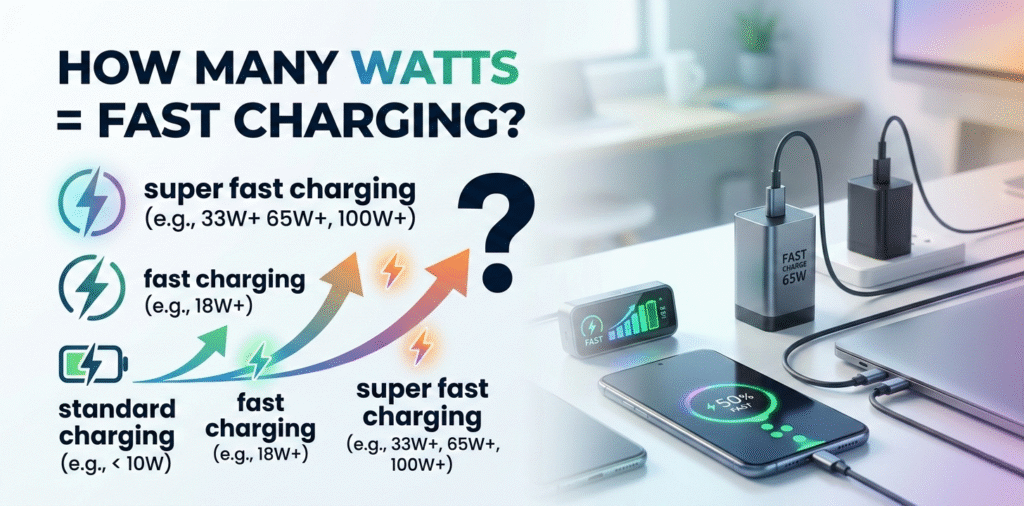
In recent years, fast charging[^1] has become one of the most sought-after features in smartphones and other electronic devices. But what exactly constitutes fast charging[^1]? Is it just about the wattage[^2], or are there other factors at play?
Fast charging usually starts at about 18W. Modern phones often use 25W, 30W, or higher; true "fast" depends on the phone's charging protocol[^3] and battery chemistry[^4].
I upgraded chargers after testing charge times. The fastest numbers mattered less than the phone’s supported protocol. Check your phone’s specs before buying a high-watt charger[^5].
Stop and confirm your phone’s supported charging standard before you buy a high-watt charger[^5].
What do people mean by "fast charging[^1]"?
I read many marketing claims and got confused.
"Fast charging" means charging significantly faster than standard 5W USB. It relies on higher power (watts) and a compatible protocol between charger and device.
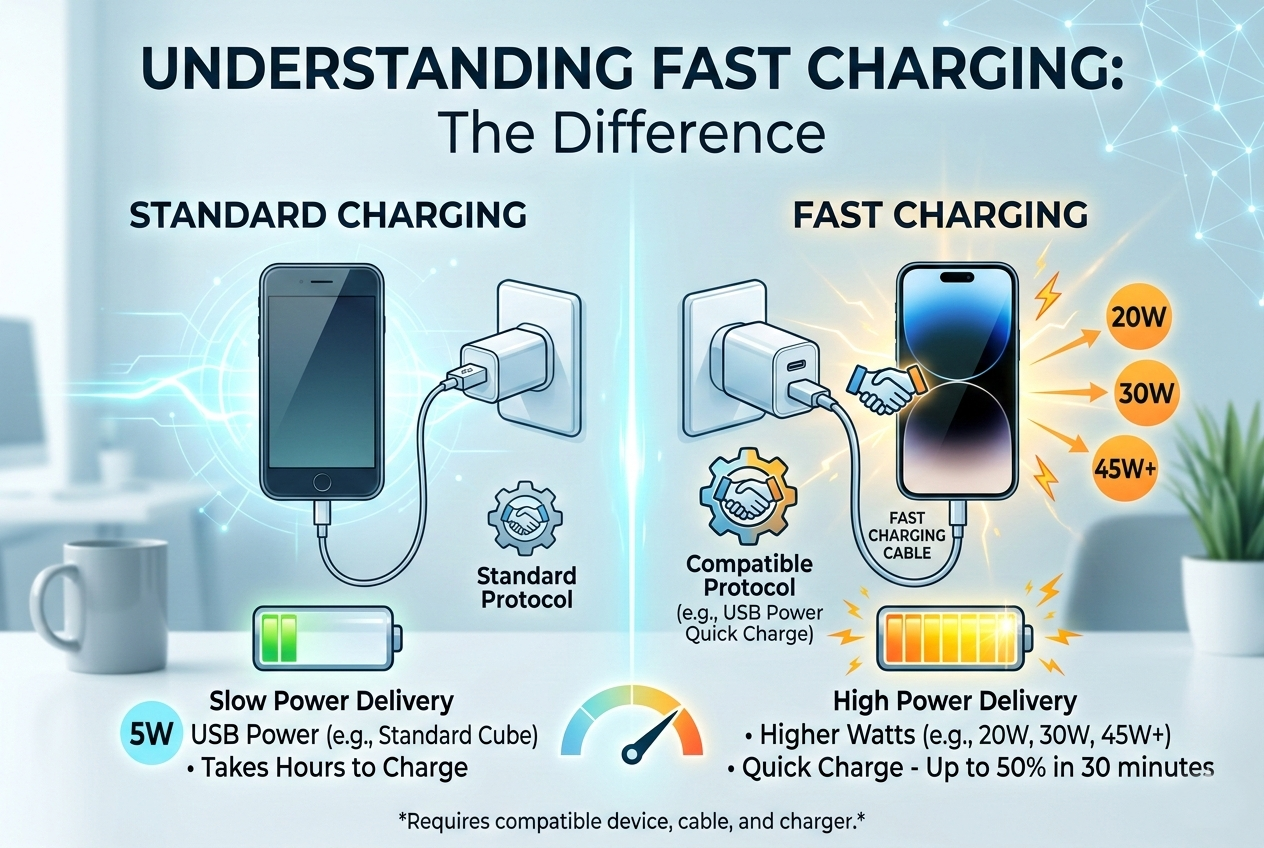
I learned that wattage[^2] alone is not enough. The phone and charger must agree on voltage and current through a handshake.
protocols, watts, and why compatibility matters Fast charging is a system, not just a number. Watts = volts × amps. Chargers increase volts, amps, or both to raise watts. Protocols like USB Power Delivery[^6] (USB-PD), Qualcomm Quick Charge[^7], Samsung AFC, OnePlus Warp, Oppo VOOC[^8], and proprietary systems define how charger and device talk. The handshake sets safe voltage and current. For example, USB-PD can negotiate 5V@3A (15W), 9V@2A (18W), 15V@3A (45W), and more. Qualcomm Quick Charge[^7] raises voltage in steps. Warp/VOOC use higher current at lower voltage. A charger rated 65W will not force 65W into a phone that supports only 18W. The phone’s internal charging circuit limits input to its maximum. Also, charging speed[^9] varies across the battery level. Fast charging is quickest from 0–50% and slows to protect battery health[^10]. Heat affects charging too. Many manufacturers trade top speed for temperature control and battery longevity. So, when choosing a fast charger, match the protocol and wattage[^2] range to your phone.
Where is the "fast" threshold in watts?
I wanted a clear cutoff for everyday phones.
Around 18W is a practical threshold for modern smartphones. Many mid-range phones accept 18–25W; flagship phones often support 30–80W or more for very fast charging[^1].
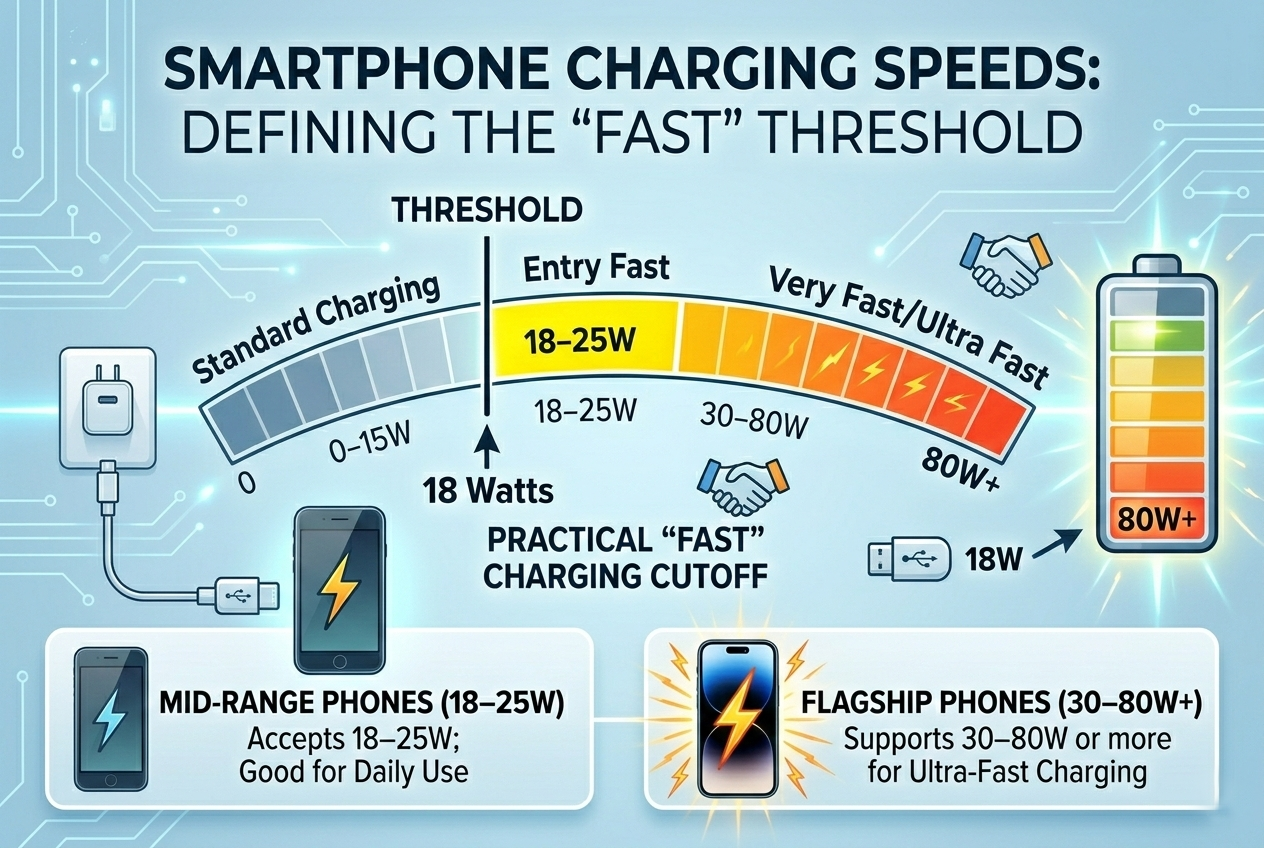
I saw 18W charge a phone faster than 5W. Higher wattage[^2] shortened full charge time more, but with diminishing returns and more heat.
tiered wattage[^2] guide and real-world expectations Use this tiered guide to set expectations. Entry-level fast charging[^1]: 10–18W. This is noticeably faster than 5W and common in many phones. Mid-range fast charging[^1]: 18–30W. This range powers many modern phones quickly to 50% in 30–40 minutes. High-speed charging: 30–65W. Flagship phones often support this for very fast top-ups. Ultra-fast charging[^1]: 65–120W or more. Some manufacturers use these rates to cut full charge times to under 30–40 minutes. However, battery size, chemistry, charging curve[^11], and thermal limits change the real speeds. A 5,000mAh battery will take longer than a 3,000mAh battery, even at the same wattage[^2]. Also, proprietary fast-charge systems may require both a special charger and cable. For most users, 18–30W strikes a good balance of speed, battery health[^10], and cost. If you choose ultra-fast charging[^1], expect more heat and potential long-term battery wear, and verify phone manufacturer guidance[^12].
How do charging protocol[^3]s affect fast charging[^1]?
I bought a high-watt charger[^5] that underperformed.
Protocols control voltage and current. The phone must support the protocol to use available watts. A high-watt PD charger helps only if the phone supports USB-PD or compatible modes.
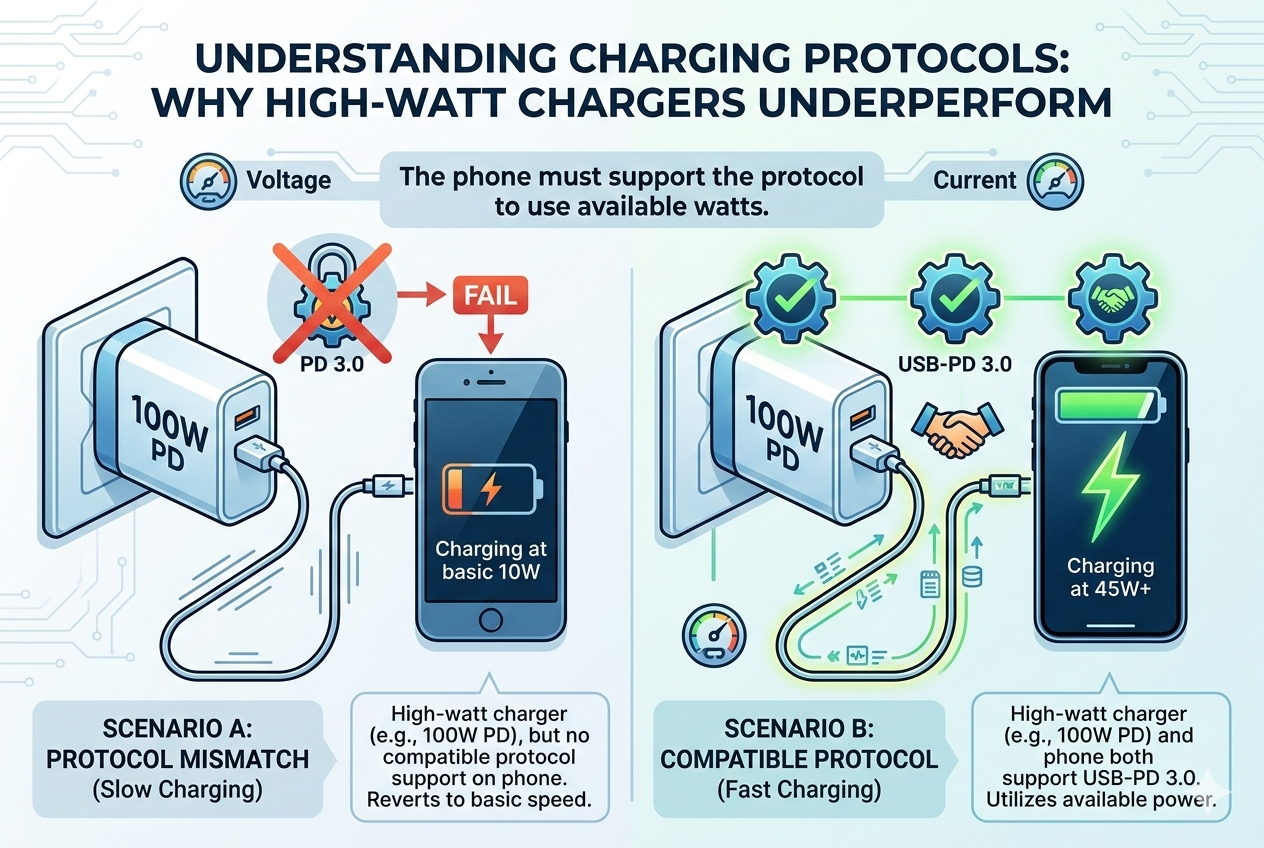
I checked my phone’s supported protocols and then matched the charger. That fixed the slow charging issue.
common standards and how to match them to your phone Know the main protocols before you buy. USB Power Delivery[^6] (USB-PD) is the broad cross-brand standard. It ranges from low-power profiles up to 240W in recent extensions. Qualcomm Quick Charge[^7] is common in many Android phones and works by increasing voltage in steps. Samsung uses Adaptive Fast Charging or supports USB-PD on newer models. Oppo, OnePlus, and Realme use VOOC, SuperVOOC, or Warp Charge; these often use high current and unique cables or chargers. Apple iPhones accept USB-PD; many recent models fast-charge at 18–27W or higher with proper PD chargers. To match, check your phone’s spec sheet for supported charging standards[^13]. If your phone lists USB-PD, choose a PD charger rated at or above the phone’s supported wattage[^2]. If it lists a proprietary system, use the manufacturer’s charger or a verified third-party that supports that protocol. Also use quality cables rated for the current. For high-watt charging, use USB-C cables[^14] rated for higher Amps (e.g., USB-C 3.1 or USB-C PD certified).
Does higher wattage[^2] damage my battery?
I worried about ruining battery life for speed.
Higher watts create more heat and faster charge cycles. Manufacturers design phones and chargers with limits to protect batteries. Using supported fast charging[^1] is generally safe, but extreme or mismatched charging can increase wear.
I followed the maker’s recommendations and avoided third-party hacks. My battery still performed well after many cycles.
battery chemistry[^4], thermal management[^15], and best practices Lithium-ion batteries age from charge cycles and heat. Fast charging increases charge rate and heat, which can speed capacity loss over long term. Phone makers manage this with thermal sensors, software throttling, and charging curve[^11]s. They often limit fast charging[^1] above certain battery percentages to reduce stress. Some phones stop fast charging[^1] after heavy use or when battery health[^10] declines. To protect battery life, avoid keeping the phone at high charge levels for long (like 100% overnight if unnecessary). Use manufacturer-approved chargers and cables. If you use ultra-fast charging[^1] frequently, expect a modest long-term capacity drop compared to gentle charging. For users who want maximum battery lifespan, prefer lower watt chargers for daily charging and reserve fast charging[^1] for occasional urgent top-ups. Also avoid charging in hot conditions and remove thick cases that trap heat while charging.
How to choose the right fast charger for your phone?
I needed a charger that works and lasts.
Match the charger wattage[^2] and protocol to your phone. Prefer reputable brands, PD or manufacturer-certified chargers, and quality cables rated for the power level.
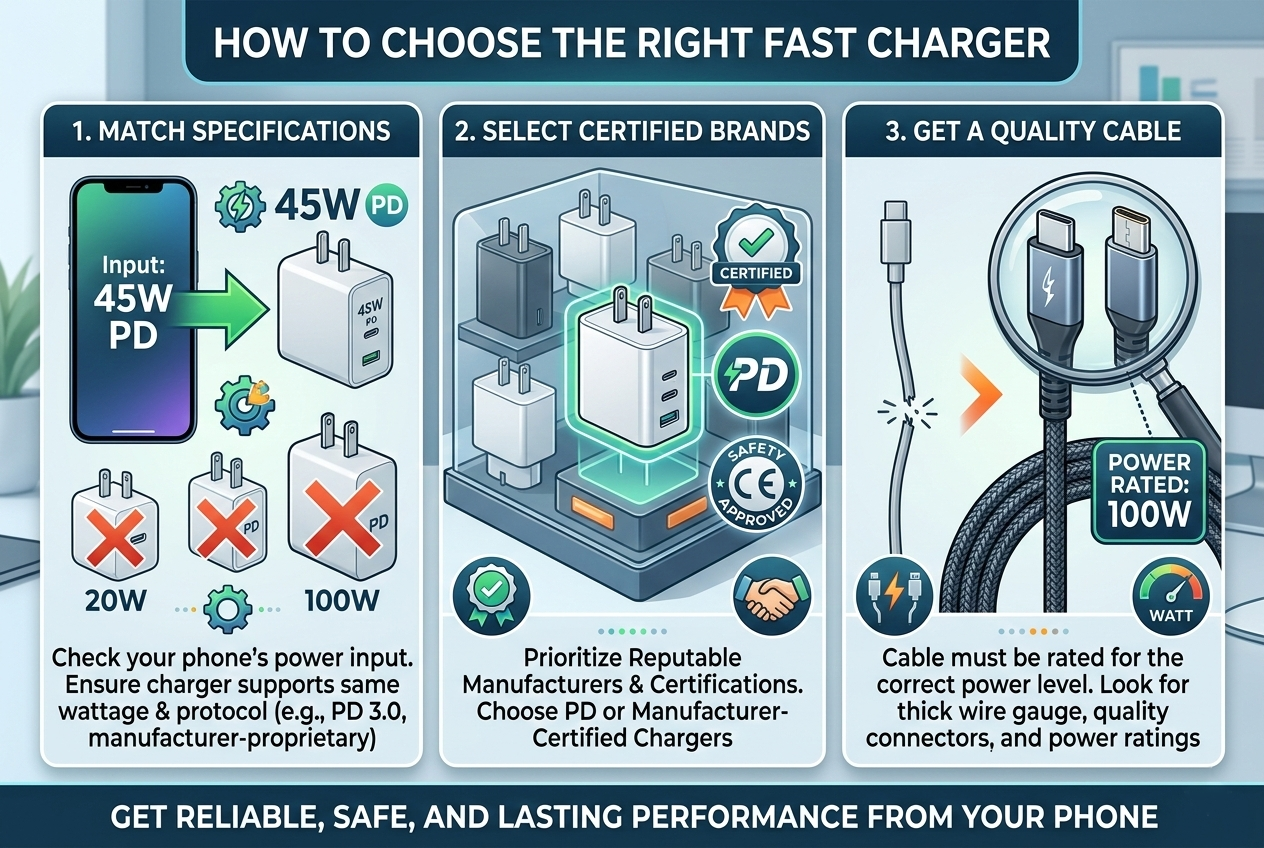
I kept one PD charger for travel and one manufacturer charger for fast top-ups. That covered most scenarios.
buying checklist and recommended setup Use this checklist when buying a fast charger. 1) Find your phone’s maximum supported wattage[^2] and protocol in the specs. 2) Choose a charger that supports that protocol and can deliver equal or higher wattage[^2]. 3) Pick quality brands with safety features: over-voltage, over-current, short-circuit protection, and temperature control. 4) Use certified cables rated for the expected current and data transfer. 5) For multi-device chargers[^16], ensure per-port limits and total power distribution meet your needs. 6) Consider compact PD chargers for travel and higher-watt chargers for desktop use. 7) Check independent tests or reviews for real-world performance[^17]. 8) Keep an original or OEM charger for warranty or support reasons. At FUMEI, we design chargers with clear wattage[^2] labels, PD support, and safety protections to match device needs while balancing speed and longevity.
Conclusion
Fast charging typically refers to anything above 10W, but true fast charging[^1] begins around 18W and can go up to 100W or more.
Charging protocols such as USB-PD, Quick Charge, and others directly impact how fast your device charges.
Higher wattage[^2] can cause heat, but modern phones are designed to manage that, reducing the risk of battery damage.
Choose the right charger based on your phone’s charging protocol[^3], wattage[^2] capacity, and brand reputation for optimal performance.
By understanding how fast charging[^1] works and choosing the appropriate charger for your device, you can charge your phone efficiently while protecting its long-term health.
[^1]: Explore this resource to understand the fundamentals of fast charging and its significance in modern devices. [^2]: Understand the role of wattage in charging performance and how to choose the right charger. [^3]: Learn about various charging protocols to ensure compatibility and optimal charging speeds for your devices. [^4]: Explore the relationship between battery chemistry and charging speed to make informed choices. [^5]: Get insights on what to look for in a high-watt charger to ensure compatibility and safety. [^6]: Discover how USB Power Delivery can significantly improve charging efficiency and speed for your devices. [^7]: Find out how Qualcomm Quick Charge technology can speed up your device's charging process. [^8]: Understand the unique features of Oppo VOOC and its impact on fast charging. [^9]: Discover the various factors that affect charging speed and how to optimize it. [^10]: Find out how fast charging practices can impact the long-term health of your smartphone battery. [^11]: Learn about charging curves and their significance in optimizing charging efficiency. [^12]: Understand the importance of following manufacturer guidelines for safe and effective charging. [^13]: Discover the common charging standards to ensure compatibility with your devices. [^14]: Explore the advantages of USB-C cables in fast charging and data transfer. [^15]: Learn about thermal management techniques that protect your device during fast charging. [^16]: Get tips on selecting a multi-device charger that meets your charging needs. [^17]: Find out how to evaluate charger performance based on real-world tests and reviews.