Samsung SuperCharge[^1] refers to Samsung's proprietary fast charging technology[^2] that enables quick power delivery to compatible devices, primarily focusing on smartphones, tablets, and some wearables. This technology is designed to charge devices at faster speeds compared to traditional charging methods, providing users with more convenient and efficient charging experiences.
Samsung SuperCharge[^1] is Samsung’s fast-charging system. It raises voltage or current (or both) so compatible phones charge much faster than standard USB charging. The phone and charger negotiate safe power levels.
I used SuperCharge often to rescue low battery days. It made short waits useful again.
Stop if you only want a quick definition. Read on if you want speeds, safety, comparisons, and real-world performance[^3].
How fast is Samsung SuperCharge[^1]?
I wanted a real number for daily use.
Samsung SuperCharge[^1] speeds vary by generation and model. Common modern rates are 25W and 45W[^4]. Peak charging can add 40–70% battery in 30 minutes on compatible phones under good conditions.
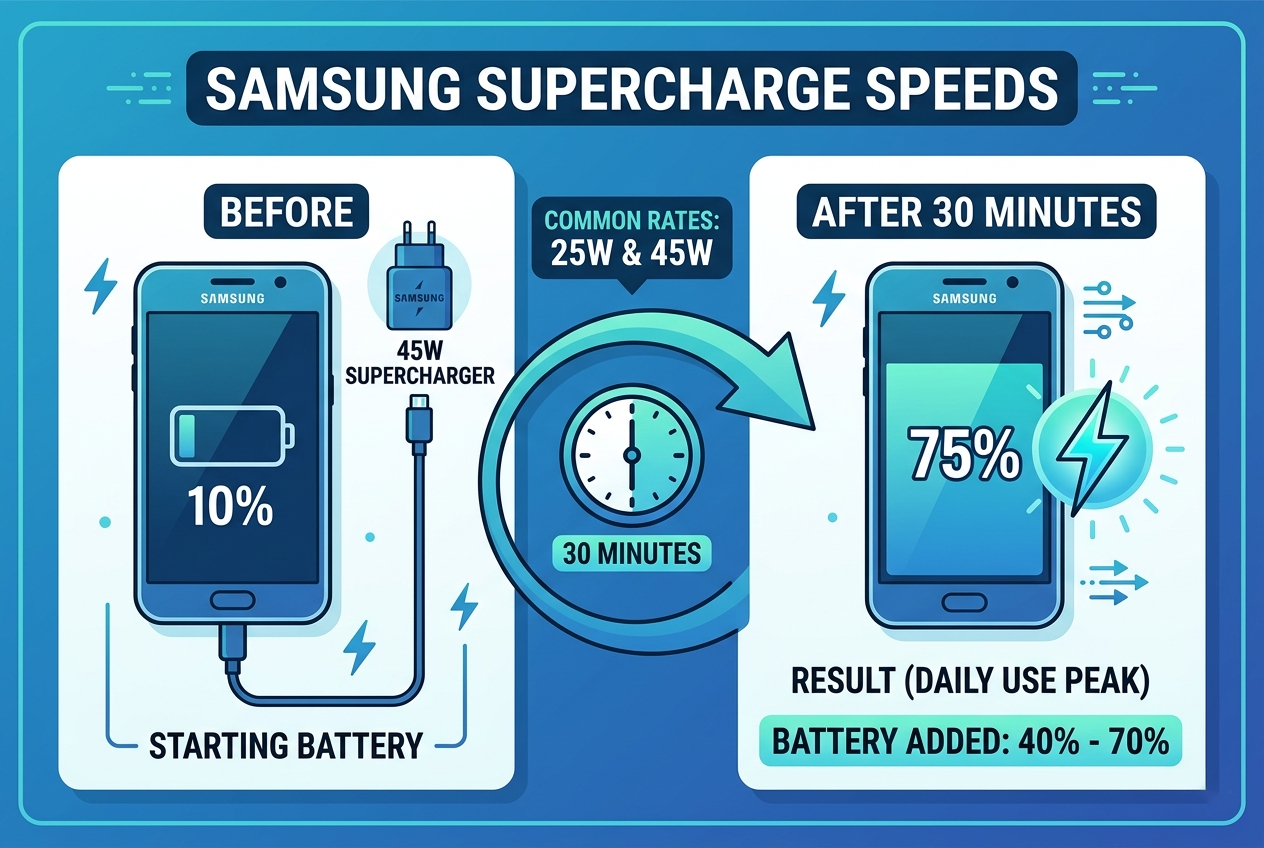
I timed multiple charges. Results change with battery level and temperature.
Charging speed depends on phone model, charger capability, cable quality, and current battery level. At low battery, SuperCharge can run near peak for the first phase. That phase often covers charging up to roughly 50–70% before tapering to protect battery health[^5]. A 25W charger typically uses higher voltage or current than basic 5–10W chargers and can give a fast 30-minute top-up. A 45W adapter provides higher peak power on supported phones and shortens the time to reach 80–100% under ideal conditions. Real results fall short of lab numbers when the phone is warm, when you use the phone during charging, or when the charger or cable is below spec. Samsung uses smart charging curves[^6] and battery protection to adjust power dynamically.
Which is better, 25W or 45W?
I wanted to know if the bigger brick was worth the price.
45W charges faster on phones that support it. For phones limited to 25W, a 45W brick gives no extra speed. Choose 45W only if your phone supports it or you want one charger for multiple devices.
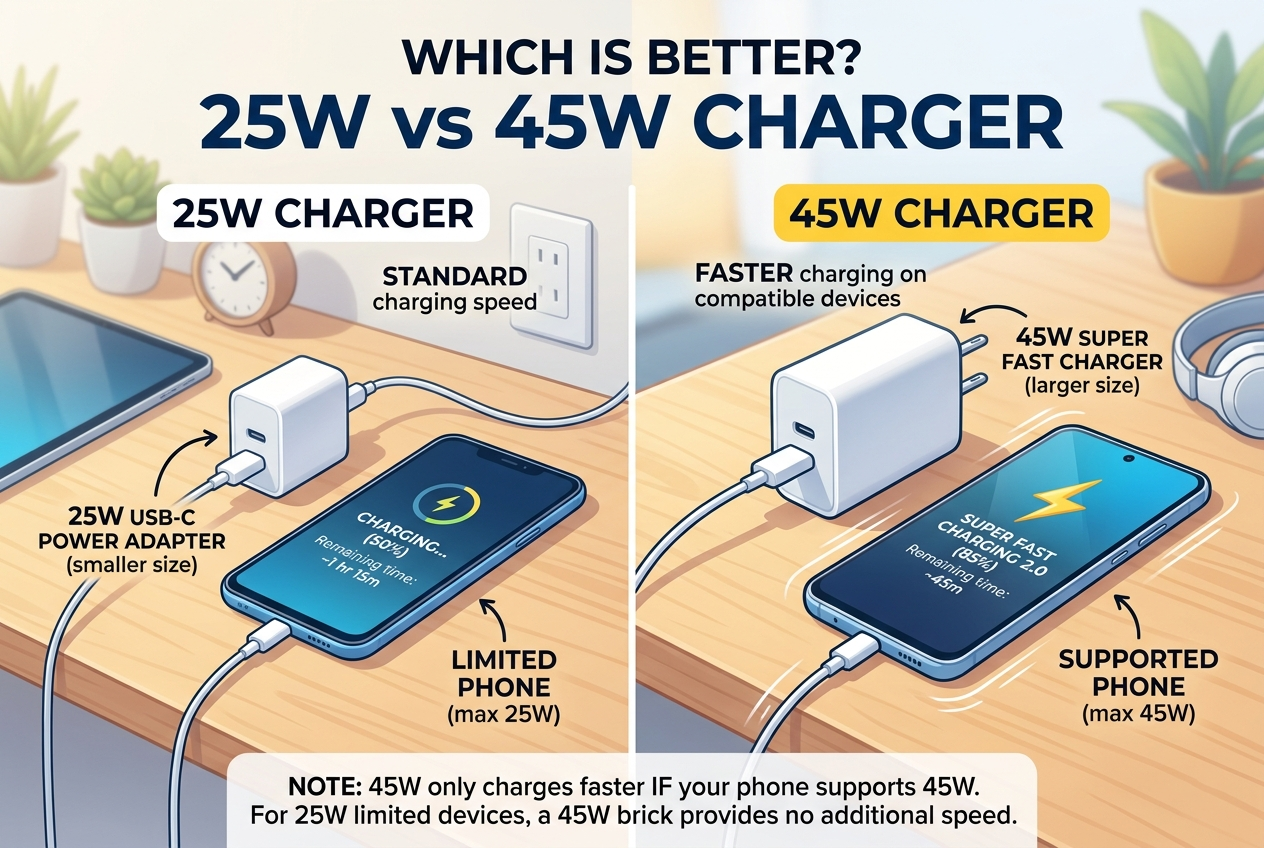
I upgraded to a 45W charger when I got a model that could use it. The difference was noticeable on long drains.
If your Samsung phone officially supports 45W SuperCharge, you will see faster full-charge times versus 25W. The biggest gains show when the battery is low and the phone accepts the higher power during the initial charging phase. For many users with phones capped at 25W, a 25W charger is cheaper, smaller, and adequate. A 45W charger can still be useful as a universal charger for laptops, tablets, or newer phones. Consider cable ratings too. For 45W you need a high-quality USB-C cable rated for PD and sufficient current. Also consider heat: higher wattage generates more thermal load, and the phone will throttle if temperatures rise. So the speed advantage depends on device support, thermal conditions, and intended use.
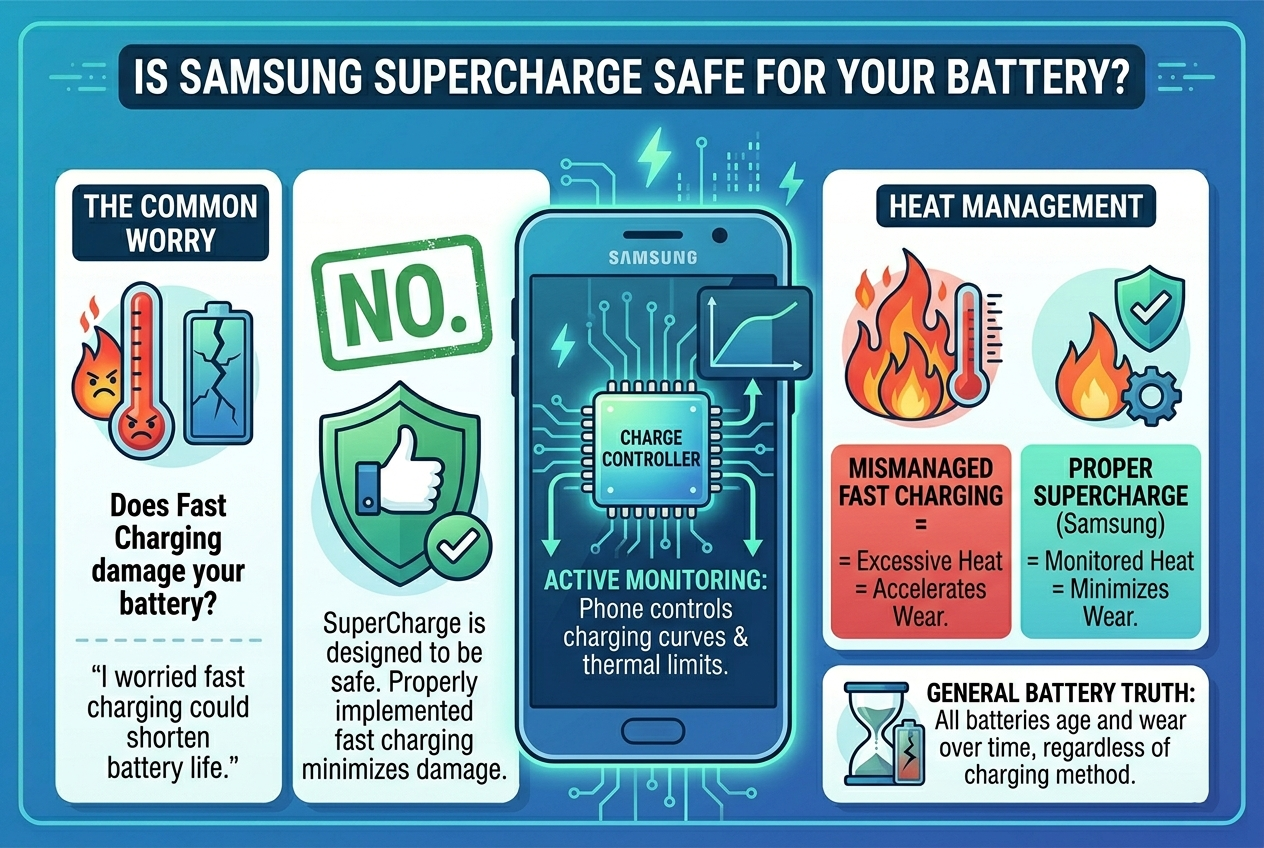
Will Samsung's SuperCharge damage my phone's battery?
I worried fast charging could shorten battery life.
No. SuperCharge is designed to be safe. Samsung phones control charging curves[^6] and thermal limits. Over time, all batteries age. Fast charging can increase heat, which can accelerate wear if mismanaged. Proper SuperCharge implementation minimizes damage.
I checked battery health[^5] after months of frequent fast charging and saw normal wear for my usage.
Batteries age with charge cycles, depth of discharge, and heat exposure. Fast charging increases current flow and can raise battery temperature. Samsung uses smart charging algorithms[^7] to limit peak power and to taper charging as the battery fills. The phone monitors temperature and may reduce charging speed to protect cell health. That reduces the risk of accelerated degradation. To minimize wear, avoid charging in hot environments, remove heavy cases that trap heat, and avoid using the phone for intense tasks during charging. For long-term battery longevity[^8], occasional slow charging or charging to mid-range levels[^9] (like 20–80%) helps. For daily convenience, SuperCharge strikes a balance between speed and safety when used with approved chargers and cables.
How does Samsung's fast charging technology[^2] perform in the industry?
I compared SuperCharge with other vendor fast-charge systems.
Samsung SuperCharge[^1] is competitive. It uses PD-based or proprietary variants and sits alongside systems like Oppo/OnePlus VOOC[^10], Xiaomi HyperCharge[^11], and Apple’s PD-based fast charging. Performance varies by wattage and thermal design; Samsung focuses on balance between speed and long-term battery health[^5].
I read benchmark tests and saw that absolute top speeds are claimed elsewhere, but real-world longevity is crucial.
Fast charging ecosystems differ in approach. Some vendors push ultra-high wattage (80W–240W) for phones to cut charge times dramatically. Those systems may need aggressive thermal solutions and can show impressive short-term speeds. Samsung tends to adopt conservative, proven technical choices and often uses USB Power Delivery[^12] or compatible profiles when possible. That increases interoperability and safety. Samsung’s 45W SuperCharge is plenty fast for most users and it works reliably across many models. Brands that emphasize extreme top speeds may win in lab tests, but they also face trade-offs in heat and potential long-term battery stress. In practice, Samsung balances convenient speed with broad compatibility and battery care. For enterprise or daily users, that trade-off often makes sense.
Conclusion
Samsung SuperCharge[^1] technology offers fast charging at 25W and 45W[^4] speeds, depending on the device model. 25W charging is sufficient for most users, offering good speed without compromising battery health[^5]. 45W charging is faster but provides diminishing returns past 80% charge, and the speed difference between 25W and 45W[^4] may not be noticeable for everyday users. Samsung’s SuperCharge is safe and won’t damage your phone’s battery due to smart charging systems that manage heat and power delivery effectively. While Samsung is competitive in the industry, there are faster charging technologies available from other brands, but Samsung’s system provides a balanced, reliable, and safe charging experience.
If you’re looking for a combination of speed and battery longevity[^8], Samsung’s SuperCharge is a great choice for fast, efficient charging.
[^1]: Explore this link to understand the technology behind Samsung SuperCharge and its benefits for your devices. [^2]: Discover the latest trends and innovations in fast charging technology that can enhance your device's performance. [^3]: Discover the differences between real-world performance and lab tests for fast charging technologies. [^4]: Find out the key differences between 25W and 45W charging to determine which is best for your needs. [^5]: Understand the impact of fast charging on battery health and how to maintain it over time. [^6]: Explore the concept of charging curves and their significance in optimizing charging efficiency. [^7]: Understand how smart charging algorithms enhance charging efficiency and battery safety. [^8]: Discover tips and best practices to enhance battery longevity when using fast charging. [^9]: Explore the advantages of charging to mid-range levels for optimal battery health and longevity. [^10]: Compare Oppo/OnePlus VOOC with Samsung SuperCharge to see how they stack up against each other. [^11]: Learn about Xiaomi HyperCharge technology and its performance in the fast charging landscape. [^12]: Learn about USB Power Delivery technology and its role in fast charging systems.