
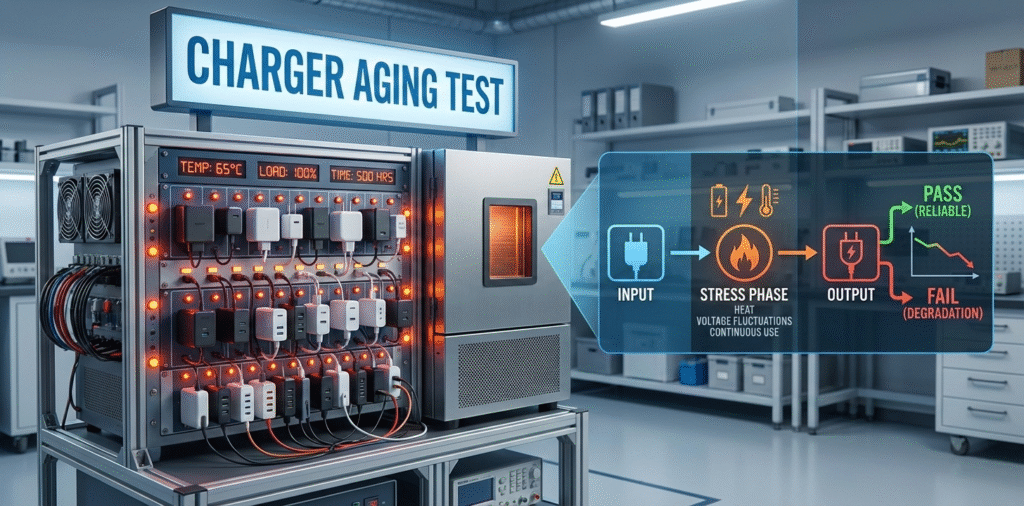
A charger aging test[^1] is a controlled reliability verification process[^2] in which chargers are operated continuously—often under full load or elevated stress conditions—for an extended period of time. The purpose is to simulate long-term real-world usage in a short time frame, allowing manufacturers to identify early failures[^3], weak components[^4], or hidden design issues before the product reaches the market.
Aging tests expose chargers to controlled stress over time to reveal early failures[^3], weak parts, and design flaws[^5] before mass production. They cut recalls and improve safety.
In the power adapter and charger industry, aging tests are a critical quality control step that bridges the gap between laboratory design validation and real-world mass production.
What is charger aging? Why must aging tests be conducted?
I break down what aging means for chargers and the practical reasons to test them.
Charger aging is the process of running devices under stress to accelerate wear and reveal early failures[^3]. We test to ensure safety, detect weak components[^4], verify thermal design, and validate manufacturing consistency.

Charger aging simulates months or years of use in days. We apply thermal stress[^6], electrical load, and on/off cycles. The goal is to surface solder joint cracks[^7], capacitor degradation, insulation breakdown, and component drift[^8]. We must do this because many failures are latent. They do not show up in short functional tests. Without aging, a small percentage of products can fail quickly in customers’ hands. That harms users and brands. Aging also verifies that safety protections work under stress. Overvoltage, short-circuit, and overtemperature protections must trigger reliably after long operation. Finally, aging checks that assembly processes are stable. If one production line yields many early failures[^3], we need to fix tooling, reflow profiles, or component sourcing. Aging tests turn random field failures into manageable factory fixes.
Why aging tests are a critical step before mass production of chargers
I explain how aging protects the supply chain, brand, and customers right before scale-up.
Aging tests catch manufacturing or design issues that only appear after extended use. They prevent large-scale recalls, ensure regulatory compliance[^9], and keep warranty costs predictable.
Before mass production, we must be confident in repeatability. Aging reveals if component tolerances, soldering, or firmware cause early failures[^3]. A single overlooked defect can cause thousands of returns. That damages reputation and margins. Aging also supports regulatory evidence. Many certifications expect reliability data and stress tests. Aging helps compile those reports. From a supply chain view, aging shows if third-party parts meet long-term needs. If a supplier’s capacitors fail after a few hundred hours, we switch sources before buying millions. For manufacturing, aging helps set pass/fail criteria, burn-in times[^10], and QA checkpoints. It also informs packaging and shipping tests, because some failures occur after transit stress combined with aging. In short, aging is the last line of defense before costly scale-up.
Enhancing Charger Long-Term Operational Stability Through Aging Tests
I describe specific aging methods and how they improve long-term stability.
Controlled burn-in, thermal cycling[^11], humidity exposure, and power cycling reveal weaknesses. Fixes include component upgrades, layout changes, and firmware adjustments to stabilize long-term operation.

Aging uses several methods. Burn-in runs units at rated load and elevated temperature for defined hours. This forces early infant-failures to show. Thermal cycling moves units between low and high temperatures to stress solder joints and materials. Humidity tests replicate corrosive environments and reveal insulation or coating failures. Power cycling repeatedly connects and disconnects loads to stress relays, connectors, and capacitors. We log failures and analyze root causes. Common fixes are changing capacitor brands to higher-temperature rated types, adding thermal vias or heatsinks, improving PCB layout to reduce hotspots, and tuning firmware to manage charge curves and thermal throttling. We may also strengthen conformal coatings or adjust potting for moisture resilience. The data from aging helps set safe operating windows and maintenance schedules. It also gives confidence to customers and certifiers that the charger will run reliably for years.
Full-Load Aging Verification of Charger Reliability Under Extreme Operating Conditions
I outline how full-load aging[^12] stresses chargers in worst-case scenarios and why that matters.
Full-load aging tests chargers at maximum rated output for extended periods, often combined with elevated ambient temperature and limited cooling. This proves the design can survive real-world extremes and sustain protection functions.
Full-load aging forces the power stage, transformers, switching transistors, and thermal management to perform at limits. We run units at rated current and voltage for many hours, sometimes days. We add elevated ambient temperatures to simulate hot environments or restricted ventilation, like inside backpacks or crowded charging stations. During these tests, we monitor output voltage stability, ripple, thermal rise at hot spots, and protection triggers. We watch for drift in output regulation, increase in noise, or creeping heat that indicates marginal cooling. If protections trip, we verify they do so safely and recover correctly. This testing reveals whether a charger can handle sustained heavy use and still meet safety and performance specs. It also guides decisions on heatsink sizing, airflow requirements, and thermal cutoff thresholds. Passing full-load aging[^12] gives strong assurance the charger will not fail catastrophically in heavy use.
I trust aging and full-load verification to turn a good prototype into a reliable product.
Conclusion
Charger aging tests are not just a quality checkpoint—they are a reliability assurance strategy.
By conducting systematic aging and full-load tests, manufacturers can:
Improve product durability
Reduce failure rates
Strengthen customer trust
Deliver chargers ready for real-world demands
For B2B buyers, aging-tested chargers represent a commitment to quality, safety, and long-term performance.
[^1]: Understanding charger aging tests can help you appreciate their role in ensuring product reliability and safety. [^2]: Explore this process to see how it enhances product quality and reduces failures in the market. [^3]: Learn how early detection of failures can save manufacturers from costly recalls and enhance safety. [^4]: Discover the significance of identifying weak components to improve charger durability and performance. [^5]: Understanding design flaws can help manufacturers create better, more reliable products. [^6]: Explore the impact of thermal stress on chargers to understand the importance of rigorous testing. [^7]: Learn about solder joint integrity to ensure the reliability of electronic products. [^8]: Understanding component drift can help in designing more stable and reliable chargers. [^9]: Explore the importance of regulatory compliance to ensure product safety and market readiness. [^10]: Learn about burn-in times to understand their role in ensuring product reliability. [^11]: Discover how thermal cycling tests can reveal weaknesses in electronic devices. [^12]: Understanding full-load aging can provide insights into how chargers perform under extreme conditions.