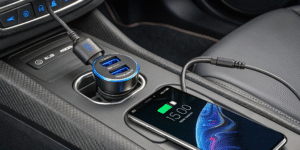
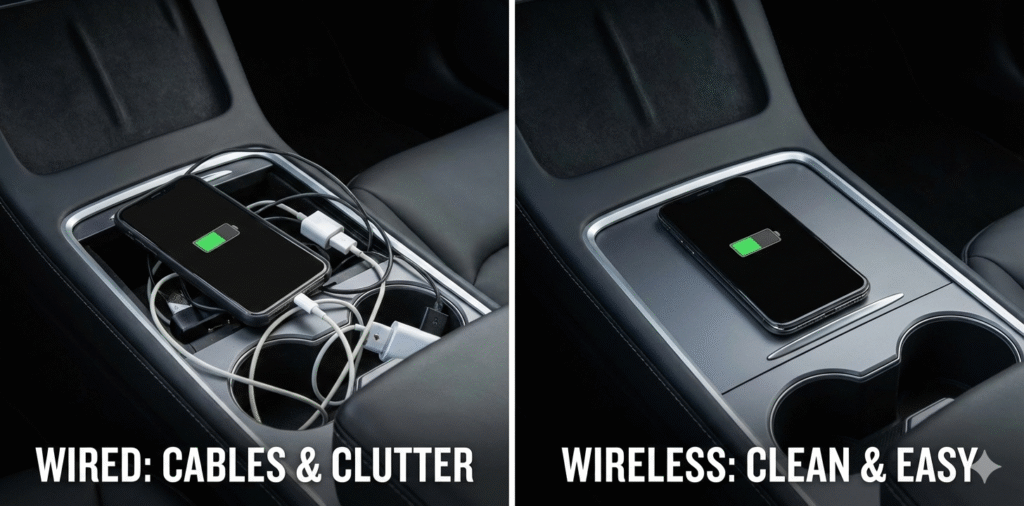
When it comes to charging your phone or other devices in your vehicle, wired and wireless car chargers are two of the most popular options. Each offers its own set of benefits, depending on the driver’s needs and the type of experience they prefer while on the road. Let's break down the advantages and disadvantages of both, so you can decide which suits you best.
Wired chargers give faster, more efficient charging; wireless chargers[^1] give simpler, one-handed convenience. Choose by your driving habits, device needs, and priority on speed versus ease.
Advantages and Disadvantages of Wired Vehicle Chargers
I used wired chargers for long drives and heavy app use.
Wired chargers charge faster, run cooler, and are more efficient. Downsides are cable clutter[^2], plug wear, and one-handed inconvenience.
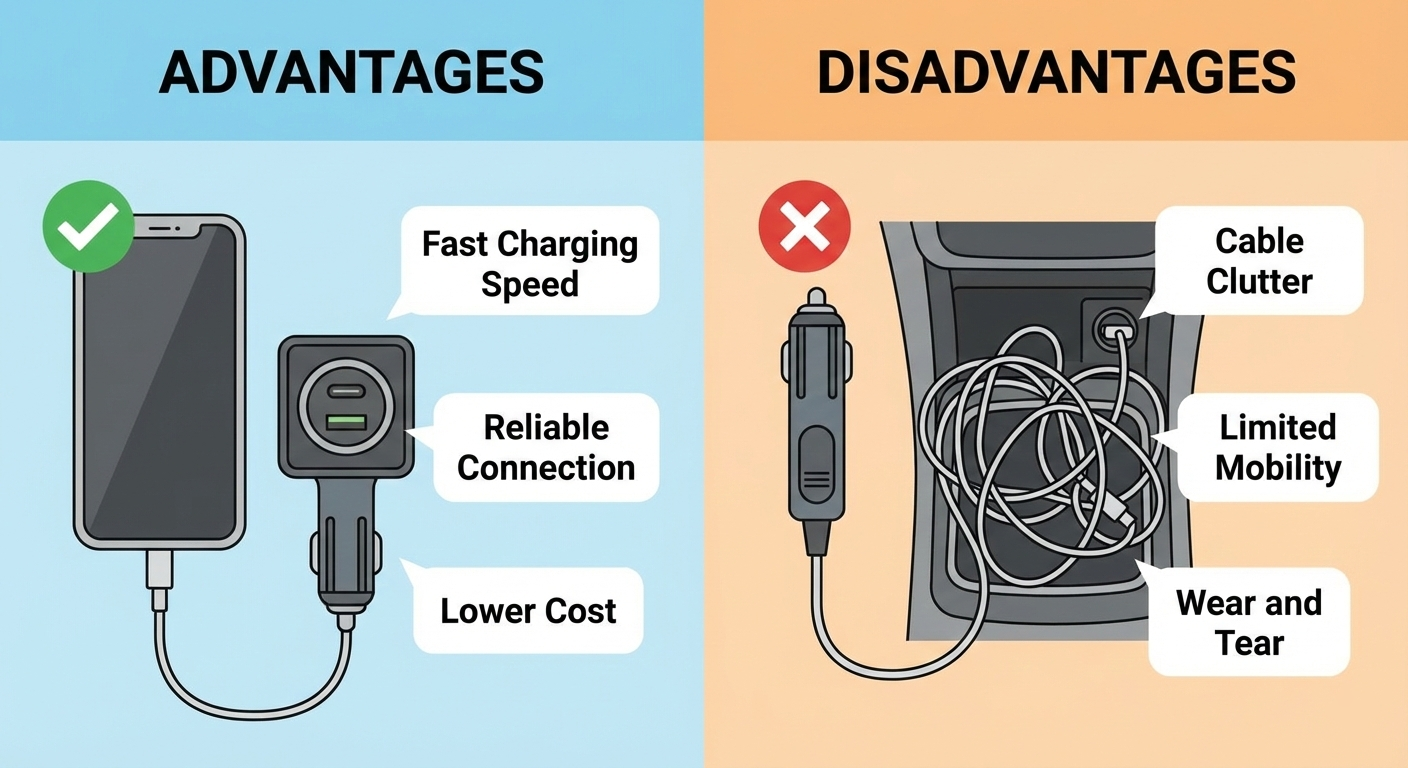
I rely on wired chargers when I need steady power. Wired USB-C PD[^3] or Quick Charge adapters[^4] deliver high current and stable voltage. They waste less energy than wireless mounts. A quality cable is the weak link. If the cable is poor, voltage drops and charging slows. Wired adapters are usually cheaper for the same power level. They work with any phone that has a charging port[^5]. The main hassles are plugging and unplugging while driving. That is one-handed less convenient. Cables also tangle or get in the way. Ports and adapters can wear over time. For best results, I pick a short, high-quality USB-C cable and a PD-capable adapter. I also use a sturdy phone holder for navigation and safety.
technical trade-offs, real-world use, and buying tips Wired charging uses a direct electrical path. That means less conversion loss and higher real-world power[^6] to the phone. For example, a 30W PD adapter often delivers close to full power to a phone. That shortens charge time and avoids overheating from inefficient conversion. I check voltage stability under load with a multimeter or a USB power meter. Good car adapters include protections: over-current, over-voltage, thermal shutdown, and short-circuit protection. Cable quality matters. Thick wires and proper shielding cut voltage drop. Long cables add resistance and reduce peak current. Also, car power outlets have fuse limits. I always verify the car’s power circuit rating[^7] and adapter continuous output. For multi-device needs, choose adapters with separate negotiation channels so each device gets the correct current. If you run navigation, video, or heavy apps while charging, wired charging keeps the phone cooler and maintains higher charging rates. For procurement, pick certified adapters and test samples under real driving conditions before buying in bulk.
Advantages and Disadvantages of Wireless Car Chargers
I switched to wireless mounts when I needed one-hand placement for deliveries.
Wireless chargers offer easy docking and less cable mess. They are slower, less efficient, and need proper alignment and compatible phones or receivers.
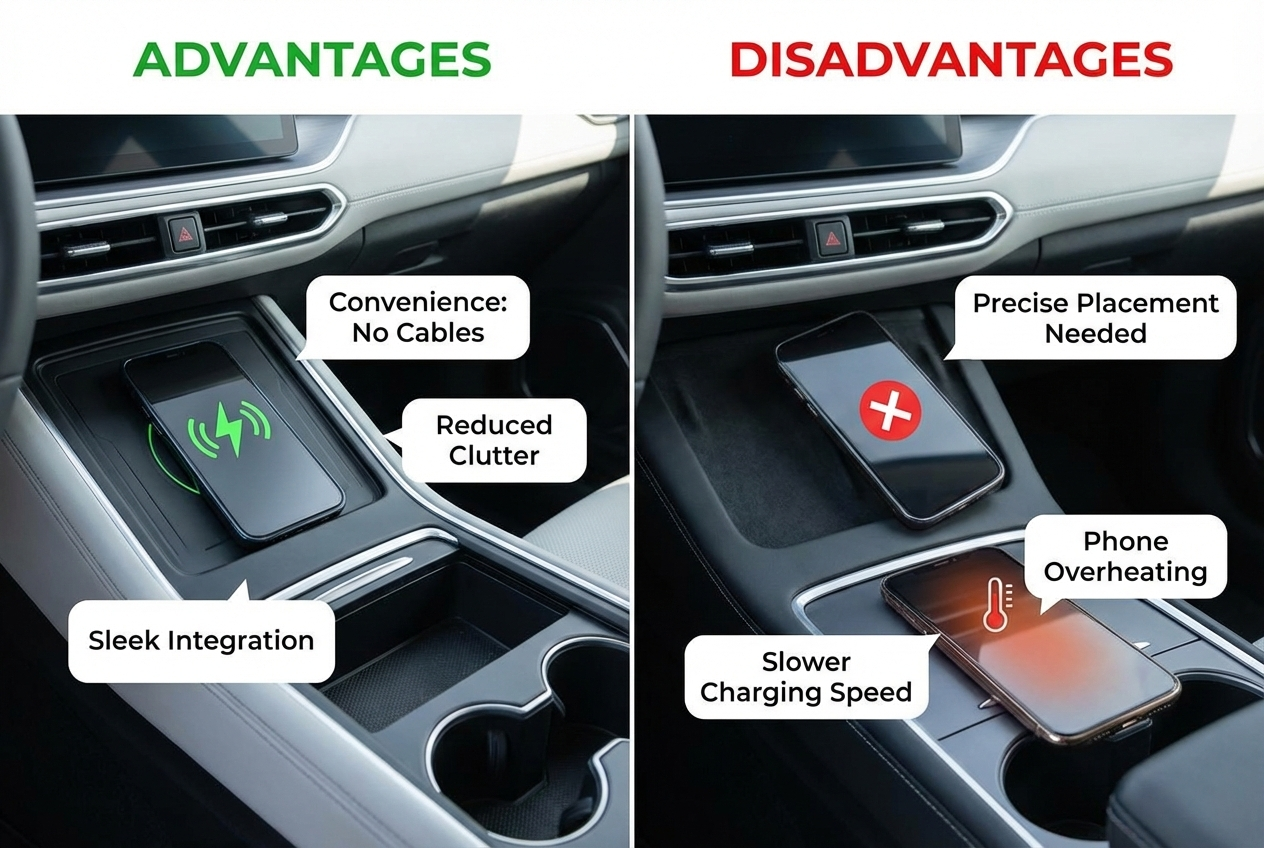
I use wireless mounts in short trips and delivery runs. Wireless mounts combine a holder and charger. They use Qi standard[^8] and can offer different output levels. Real output is often lower than advertised because of coil alignment and distance. Wireless systems run hotter due to conversion losses. Phones may throttle charging when hot. Cases, metal objects, and thick materials can block charging. On rough roads, a poor mount loses alignment. For safety, choose mounts with FOD (foreign object detection)[^9], thermal protection[^10], and secure grips.
performance, heat, compatibility, and installation tips Wireless charging uses inductive coupling[^11] between coils. Efficiency drops when the phone is misaligned or sits in a thick case. For real-world use, I pick mounts with clamps or magnetic centering. Magnetic mounts that match Qi specs help alignment but may limit accessories. Heat is the main downside. Coil inefficiency creates heat in both mount and phone. Phones running navigation or heavy apps add to that heat. Many phones reduce wireless charge current under high temperature. For stable charging, I test mounts with my phone, case, and in-car position. Check the mount’s input requirements. Many wireless mounts need 18–30W input to deliver 7.5–15W to the phone after losses. Also, verify the mount attaches securely to vents, dash, or windshield. Vent mounts can block airflow. Adhesive mounts may not stick to textured dashboards. For delivery drivers or frequent users, pick mounts with strong clamps and ventilation. Remove metal cards or magnetic wallets. Use thin, wireless-friendly cases or remove the case while charging for better performance.
Comparing Charging Speeds: Wired vs. Wireless
I measured charging speed[^12]s on real drives.
Wired charging usually delivers significantly higher power and faster charge times than wireless charging under similar conditions.
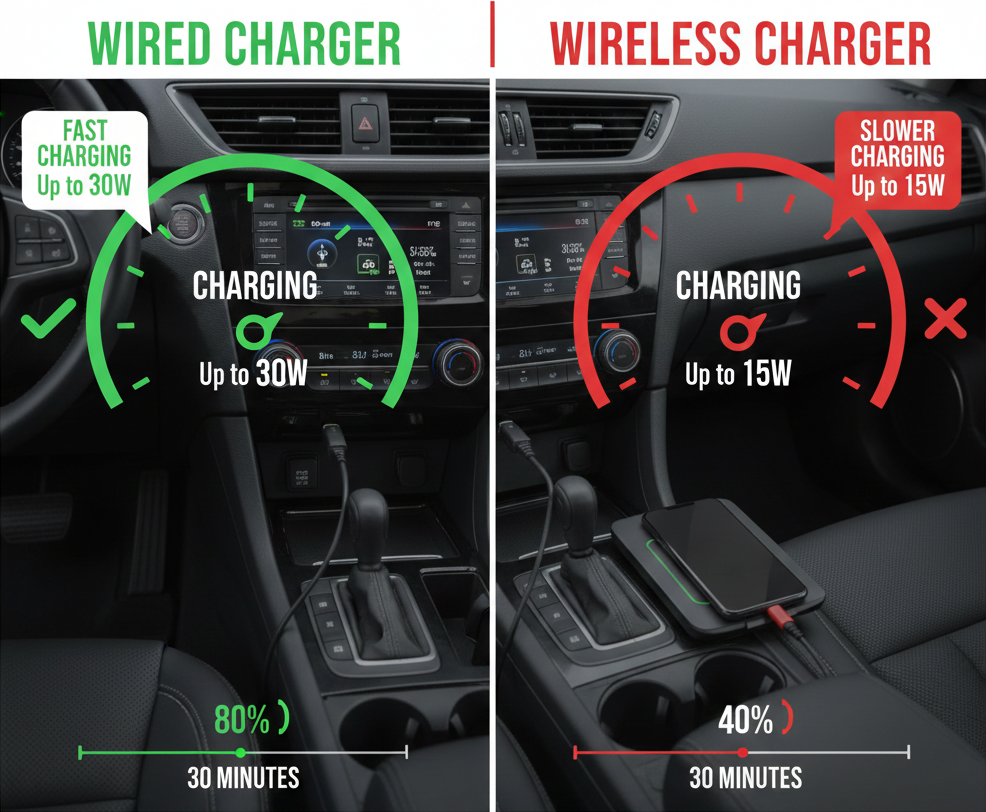
I found wired PD adapters deliver closer to advertised wattage. Wireless mounts often fall short due to coil losses and alignment issues. Also, thermal throttling affects wireless charging more. If you need quick top-ups between stops, wired wins. If you want steady but slower charging during short stops, wireless may be acceptable.
measured examples, throttling, and real-world implications In my tests, a good wired PD adapter with a short USB-C cable charged a phone from 20% to 80% far faster than a quality Qi mount. For instance, a 30W wired setup completed a rapid top-up nearly twice as fast as a 10W wireless mount. Wireless mounts advertise up to 15W, but real output commonly sits at 7.5–10W under typical conditions. Heat makes this worse. Wireless systems and phones heat up, leading phones to cut charging current[^13] to protect the battery. In heavy-use scenarios—navigation, streaming, Bluetooth calls—the phone draws current while charging. This increases temperature and further reduces net charge speed, especially for wireless setups. For devices that support fast wired charging, wired remains the recommended option for time-sensitive charging. For casual use where speed is not critical, a wireless mount can keep the battery topped up and offers easier handling.
Convenience: Wired vs. Wireless Charging in Different Scenarios
I match charger choice to the trip and use case.
Wired is best for long trips, heavy app use, and fast top-ups. Wireless is best for short runs, deliveries, and hands-free single-handed docking.
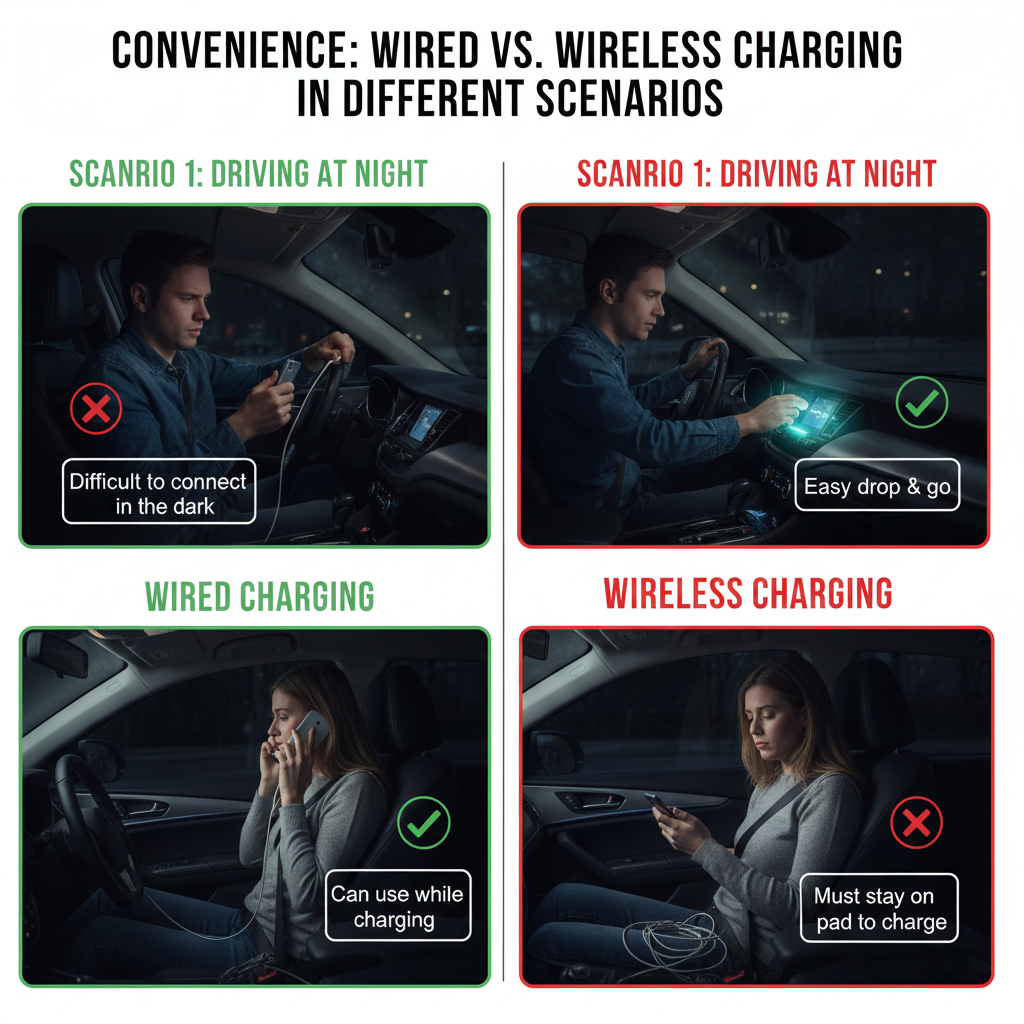
I choose based on routine. For daily commuters who park and walk, wireless offers simple in-and-out use. For drivers who rely on long navigation sessions or need rapid top-ups between meetings, wired is better. For family cars, a wireless mount reduces cable fights and simplifies device sharing.
scenarios, mounting tips[^14], and hybrid solutions Think about scenarios. For long highway drives, wired charging keeps battery and phone cool and fills capacity fast. I use a PD car adapter and a short USB-C cable. I mount the phone for navigation but keep it connected via cable. For delivery drivers and anyone who frequently pick up and drop the phone, a wireless mount wins for speed of access. Choose mounts with secure clamps or magnetic alignment to prevent the phone from shifting on bumpy roads. For rideshare drivers, wireless mounts reduce passing cables between passengers. For families, wireless reduces wear on multiple cables. I often recommend a hybrid setup[^15]: keep a PD wired adapter in the glovebox and a Qi mount on the dash. That gives the fastest option for long trips and the easiest option for quick stops. When buying, check certifications, thermal protection[^10], and real user reviews[^16]. Test the combination of your phone, case, and car before committing.
Conclusion
Ultimately, the choice between a wired car charger and a wireless car charger depends on your personal preferences and needs:
Go for a wired charger if you value faster charging speed[^12]s and don’t mind dealing with cables. It's also the better choice for charging multiple devices at once and ensuring rapid power-ups.
Opt for a wireless charger if you prioritize convenience, a clutter-free setup, and don’t mind a slightly slower charging experience. Wireless charging is perfect for people who need quick top-ups without the hassle of cables.
Choosing the right one comes down to how you use your car charger and what fits your lifestyle best. Either way, both options offer a level of comfort that makes charging in your vehicle more accessible than ever.
[^1]: Discover the convenience of wireless chargers, ideal for hands-free use and reducing cable clutter. [^2]: Get tips on reducing cable clutter in your car for a cleaner and more organized space. [^3]: Understand how USB-C Power Delivery enhances charging efficiency and speed for your devices. [^4]: Find out how Quick Charge technology can provide rapid charging for compatible devices. [^5]: Understand the different types of charging ports and their compatibility with various devices. [^6]: Learn about the factors that influence real-world power delivery and charging efficiency in vehicles. [^7]: Find out how to verify your vehicle's power circuit rating to ensure safe and efficient charging. [^8]: Learn about the Qi standard and its significance in ensuring compatibility among wireless chargers. [^9]: Discover how FOD technology enhances safety by preventing foreign objects from interfering with charging. [^10]: Learn about the importance of thermal protection in chargers to prevent overheating and ensure safety. [^11]: Explore the technology behind wireless charging and how inductive coupling works to power your devices. [^12]: Learn about the significant differences in charging speeds and how they impact your device's performance. [^13]: Understand the role of charging current in determining how quickly your device charges. [^14]: Get practical advice on how to securely mount your chargers for optimal performance and safety. [^15]: Discover the benefits of a hybrid charging setup that combines wired and wireless options for versatility. [^16]: Learn how to evaluate user reviews to make informed decisions when purchasing car chargers.