My phone died at the airport because I forgot the right adapter.
Italy uses Type C and Type F plugs[^1] widely, plus a distinct older Type L standard[^2]. Bring a travel adapter[^3] that supports Type C/F and Type L, and a USB-C PD charger[^4] for fast device charging.
I once carried only a Type A adapter and had to buy a replacement at a high price. I now pack a compact multi-region adapter[^5] and a small PD charger.
Stop if you only need a quick shopping list. Read on if you want details on compatibility, safety, and what to buy.
Can European plugs be used in Italy?
I wondered if a standard European plug would work.
Yes. Most continental European plugs (Type C and Type F) work in Italy. Type C fits most sockets. Type F fits where German-style grounded sockets are present. Check for Type L in some hotels or older buildings.
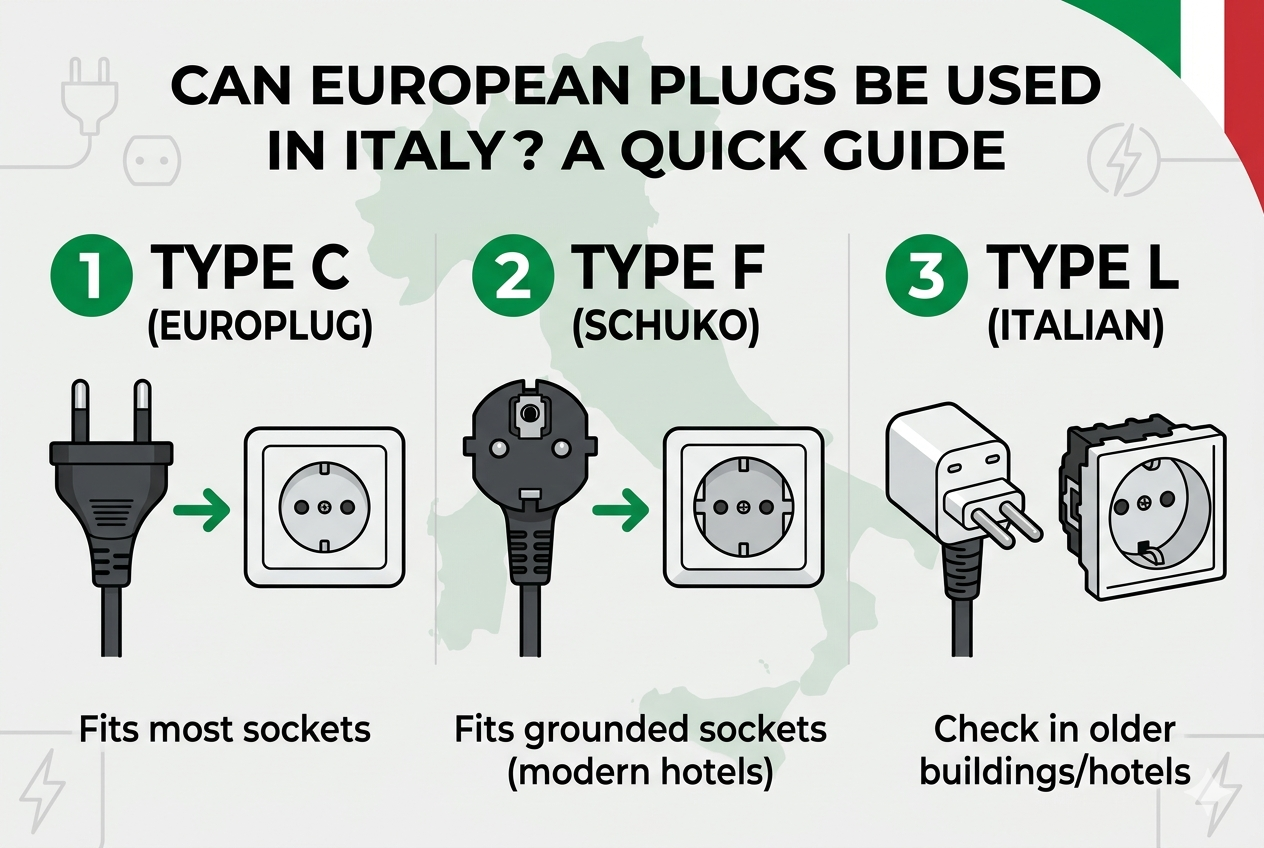
I used a Type C plug from another country and it fit fine in city hotels. Rural inns sometimes had older sockets.
plug compatibility[^6], socket variations, and where to expect exceptions Italy mostly accepts the common Europlug (Type C) and the Schuko plug[^7] (Type F). The Europlug is two round pins without grounding. It works in many low-current devices like phone chargers. Schuko (Type F) has two round pins plus side grounding clips. It fits securely into compatible sockets and supports higher current devices. The Italian Type L is different; it uses three inline pins and comes in two sizes (10 A and 16 A). Many modern sockets accept both Type C and Type F. Yet, in some older buildings and rural accommodations you may find only Type L or older Italian variants. Hotels in tourist areas often provide modern sockets. For appliances that require grounding, prefer an adapter that supports Schuko. For convenience, a travel adapter[^3] that accepts multiple plug types and provides USB-A and USB-C PD ports covers most needs. Always check the socket at your accommodation on arrival to avoid surprises.
What does the Italy adapter look like?
I wanted to recognize the adapter in stores quickly.
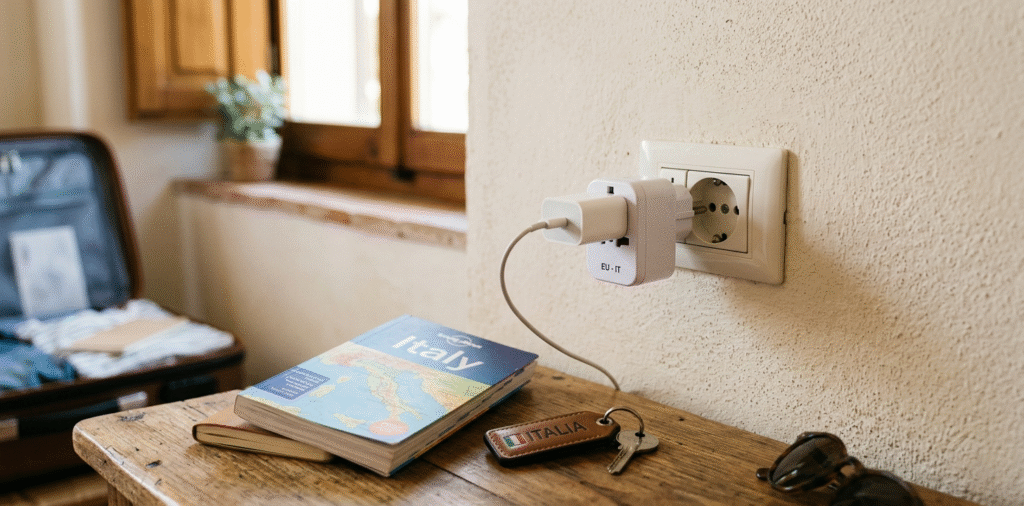
A Type L Italian adapter has three inline round pins in a straight line. Type C and Type F adapters show two round pins. A travel adapter[^3] for Italy often shows multiple socket holes and may include grounding contacts or a slider for different plug types.
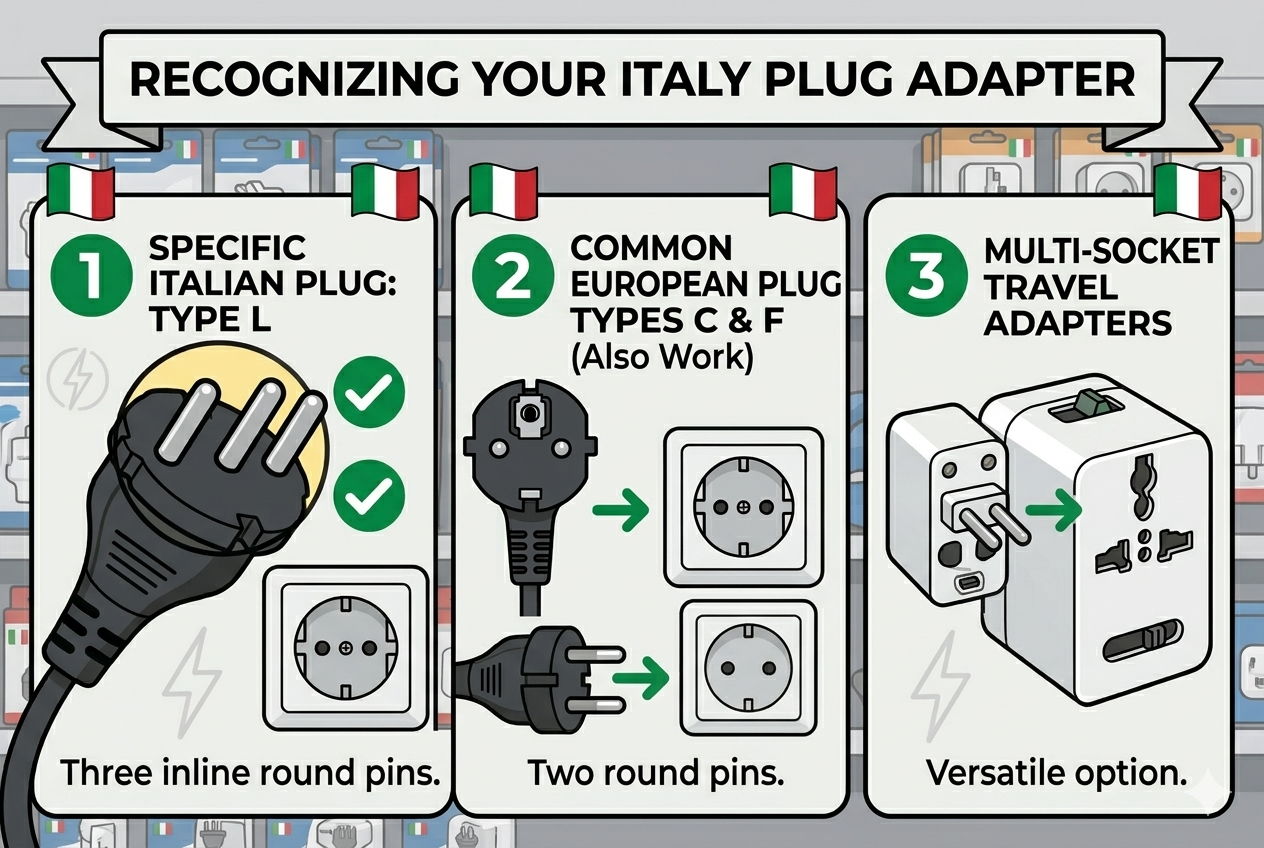
I bought a multi-adapter with clear labels for Type L and Schuko. It made plugging in stress-free.
visual features, plug sizes, and choosing the right adapter Type L plugs are easy to spot. The three pins are in a straight line, spaced evenly. The smaller 10 A Type L pins are thinner and closer together. The 16 A version uses thicker pins spaced slightly wider. Type C and Type F both have two round pins. Type F also needs grounding via side contacts or recesses in the socket. A good Italy travel adapter[^3] shows socket holes to accept Europlugs and Schuko plug[^7]s. It often includes holes for UK or US plugs too. Choose an adapter that lists compatibility with Type C, F, and L. If you need to plug in high-power devices like hair dryers, pick an adapter rated for the correct current and with a grounding connection[^8]. Some multi-adapters include built-in surge protection[^9] or USB ports. For fast charging, prefer adapters that pass through full current or offer a USB-C PD port rated 30W or higher.
Why does Italy have two plugs?
I was puzzled by the mix of plug types across the country.
Italy uses multiple plug standards due to historical development and different technical needs. Type L is the national standard from mid-20th century, while Type C and Type F became common through European harmonization and imports. Buildings of different eras keep different sockets.
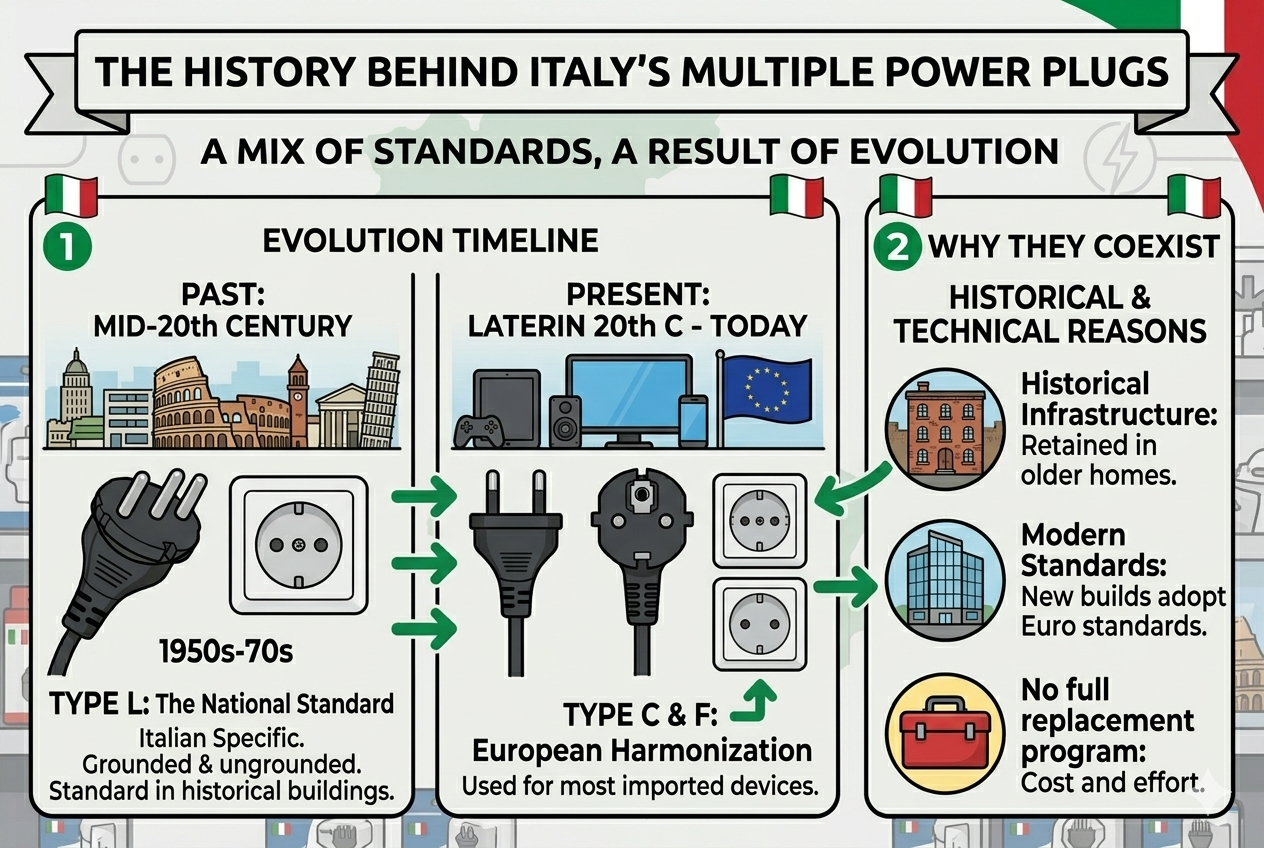
I learned that older buildings kept original wiring, so sockets vary by region and age.
history, standardization, and practical impact for travelers Italy originally adopted the three-pin Type L plug as a national standard in the mid-1900s. The design provided grounding and suited domestic wiring practices. Later, Europe moved toward harmonizing plugs. The two-pin Europlug (Type C) spread across the continent for low-power devices because it is small and ungrounded. Schuko (Type F) came from neighboring countries like Germany and is common with higher-power grounded appliances. As travel and trade increased, sockets and plugs from different eras coexisted in Italy. Renovations and new constructions often use Schuko or universal sockets that accept multiple plug types. This patchwork explains the mix travelers see today. For travelers, the practical lesson is to expect variety. Carry a compact adapter that covers Type C/F and Type L. If you plan to use high-wattage appliances, choose an adapter that provides proper grounding and current rating for safety.
Practical packing list and safety tips
I needed a simple checklist to prepare.
Pack a multi-region travel adapter[^3] that supports Type C/F and Type L, a USB-C PD charger[^4] (30W–65W), at least one quality USB-C cable rated for PD, and a travel surge protector if you plan to use multiple devices.
I follow this checklist now and avoid last-minute trips to overpriced airport shops.
recommended products, current ratings[^10], and safe usage tips Choose an adapter rated for at least 250 V and 10–16 A to match Italian mains (230 V, 50 Hz). For small electronics, a simple Type C adapter works. For laptops or hair dryers, use an adapter with grounding and correct current rating. A compact USB-C PD charger[^4] (30W for phones and light laptops, 45–65W for heavier laptops) reduces the number of bulky plugs you need. Use quality cables marked for PD and the appropriate wattage. Avoid cheap adapters that lack grounding or safety certifications (CE, RoHS). If your device does not support 230 V, use a voltage converter[^11], but most modern chargers handle 110–240 V automatically. Always plug heavy appliances directly into a grounded adapter. For peace of mind, buy a universal adapter[^12] with built-in fuse or surge protection[^9]. Test adapters at arrival and inspect sockets for damage before use.
Conclusion
Bring a multi-adapter covering Type C, F, and L, a USB-C PD charger[^4], and quality cables for safe and hassle-free charging in Italy.
[^1]: Understanding these plug types is essential for travelers to ensure compatibility with devices. [^2]: Learn about the Type L standard to avoid issues with older sockets in Italy. [^3]: Finding the right travel adapter can save you from expensive replacements and ensure device compatibility. [^4]: A USB-C PD charger is crucial for fast charging; knowing its benefits can enhance your travel experience. [^5]: A multi-region adapter simplifies charging needs across different countries, making travel easier. [^6]: Understanding plug compatibility helps you avoid surprises when charging devices in different locations. [^7]: Discover the Schuko plug's features to ensure you have the right adapter for high-power devices. [^8]: Learn about grounding connections to ensure safety when using high-power appliances. [^9]: Surge protection can prevent damage to your devices, making it a smart choice for travelers. [^10]: Understanding current ratings helps you choose the right adapter for your devices' power needs. [^11]: Knowing when to use a voltage converter can prevent damage to your electronics while traveling. [^12]: A universal adapter can be a lifesaver for travelers, providing compatibility with various plug types.