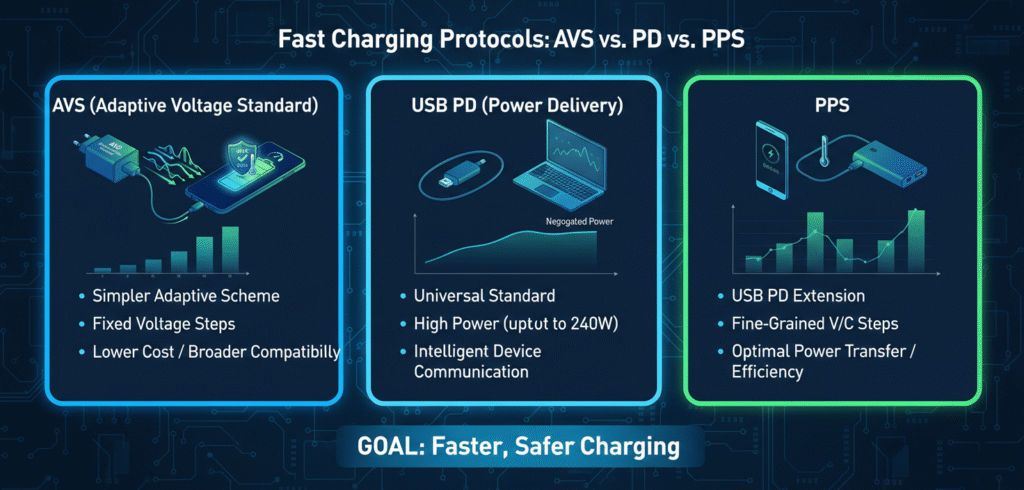
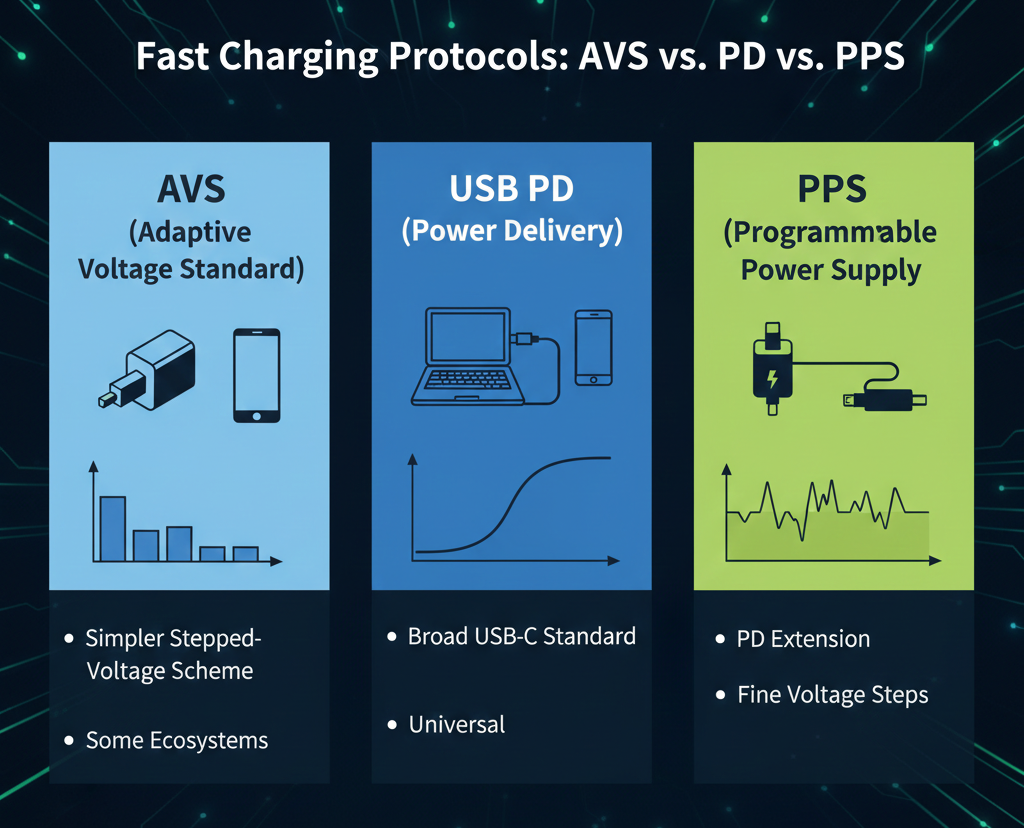
AVS, PD, and PPS are charging protocols. PD (USB Power Delivery[^1]) is a broad USB-C standard. PPS (Programmable Power Supply[^2]) is a PD extension with fine voltage steps. AVS (Adaptive Voltage Standard[^3]) is a simpler stepped-voltage scheme used in some ecosystems.
I compare these protocols when I source chargers. The choice affects compatibility[^4], charging speed[^5], cost, and firmware needs[^6]. Knowing the differences helps me match chargers to devices and avoid returns or complaints.
If you buy or make chargers, first map devices to protocols, then pick chargers that match or include fallback modes for widest compatibility[^4].
How is USB Power Delivery[^1] (PD) different?
USB Power Delivery[^1] is a standardized USB-C protocol. It negotiates fixed voltage[^7]/power profiles via digital messages and supports many device types including phones, tablets, and laptops.
I choose PD when devices need a reliable, unified solution across vendors. PD uses USB-C power-role negotiation[^8] and supports up to high wattages depending on implementation.
PD features, how it negotiates, and practical implications USB Power Delivery[^1] is part of the USB-C ecosystem. It uses the CC (configuration channel) pins to exchange PD messages. The source (charger) advertises power profiles called PDOs (power data objects). The sink (device) requests one PDO, which sets voltage and current. PD supports fixed voltage[^7]s like 5V, 9V, 15V, 20V and up to high wattages (for example 100W in many PD specs). Newer PD versions and EPR allow even higher voltages. PD is digital and flexible. It supports role swap, power rules, and standardized safety checks. For manufacturers and buyers, PD means wide interoperability across modern USB-C devices. It requires USB-C connectors and PD-capable controller ICs in both ends. PD adapters and chargers are usually more expensive than legacy chargers because of the controller and certification. If you need cross-device compatibility[^4] and higher power delivery (laptops or fast phone charging), PD is the preferred choice.
How does PPS (Programmable Power Supply[^2]) differ from PD?
PPS is an extension of USB PD that allows the sink to request fine-grained voltage and current within a range. It reduces heat by letting the device pick an optimal voltage instead of fixed steps.
PPS technical details, benefits, and requirements PPS enhances PD by allowing a continuous or finely stepped voltage window rather than fixed PDOs. For example, a PPS source can offer 3.3V–21V in small steps (often 20mV). The sink requests an exact voltage and current combination via PD messages. This fine control reduces the dissipation in the phone’s internal power conversion stage. Less dissipation means less heat and better charging efficiency[^9]. PPS is ideal for fast-charging protocols where thermal limits matter. It needs PD controllers that support PPS and compatible firmware in both charger and device. In practice, chargers advertise an APDO (adjustable PDO) and the phone negotiates the best point. PPS typically requires a USB-C to USB-C PD path and good PD cable rating. For buyers, choose a PD+PPS charger and good cable when devices list PPS support. This gives the most efficient USB-C fast charging for many recent phones.
How does AVS (Adaptive Voltage Standard[^3]) differ from PD and PPS?
AVS is a simpler adaptive-voltage protocol. It negotiates stepped voltages using simpler signaling. AVS often appears in ecosystems that favor low cost and backward compatibility[^4] with older ports.
I pick AVS when devices require compatibility[^4] with legacy chargers or when buyers want lower BOM cost versus full PD/PPS solutions.
AVS mechanics, use cases, and trade-offs AVS negotiates voltage steps between charger and device. The signaling methods vary by ecosystem. Some AVS variants use coded voltage pulses or data-line tricks rather than full PD messages. AVS supports predefined voltage levels and switches among them during charging. It reduces complexity and cost compared with PPS because it needs simpler controllers and less firmware. AVS works well for phones and accessories in markets where manufacturers share the same adaptive-voltage standard. However, AVS lacks the fine granularity of PPS and the broad USB-C integration of PD. That means AVS may not achieve the same thermal efficiency or the high wattages available with PD/PPS. AVS is useful in legacy USB-A or micro-USB ecosystems or in low-cost USB-C adapters where full PD stacks are not justified. For procurement, check the device compatibility[^4] list and test real charge curves to confirm expected performance.
Which protocol should you choose for different use cases?
Use PD for broad USB-C compatibility[^4] and high power. Use PPS when your device supports it for best thermal efficiency. Use AVS for cost-sensitive or legacy ecosystems where compatibility[^4] with specific devices matters.
I match chargers to devices to avoid customer complaints and returns. That saves money and time.
decision table, buying checklist, and testing tips I use a simple decision matrix when selecting chargers. First, list device models and check their supported protocols. If most devices list USB PD, choose PD chargers with appropriate wattage. If devices support PPS and you want fast, cool charging, pick PD chargers that also support PPS. If devices are older or from an AVS ecosystem, choose AVS-compatible chargers or multi-protocol chargers[^10] that include AVS fallback. For mixed-device batches, prefer multi-protocol chargers[^10] that advertise PD, PPS, and legacy support. When buying, check certification (USB-IF for PD, vendor certifications for AVS), ask for test logs, and run real-world tests with the devices at various battery states. Test for heat, charging curve, and behavior under partial loads. Use quality cables rated for PD/PPS, and check thermal performance[^11] over repeated cycles. For safety, require over-voltage, over-current, short-circuit, and foreign object detection. This approach reduces warranty issues and improves customer satisfaction.
Match protocol to device needs, test chargers with your device list, and require certification and thermal reports before purchase.
Conclusion
PD is the broad USB-C standard; PPS adds fine programmable steps for efficiency; AVS is a simpler adaptive-voltage scheme for cost-sensitive or legacy ecosystems.
[^1]: Explore this link to understand the fundamentals of USB Power Delivery and its significance in modern charging solutions. [^2]: Learn about PPS and how it enhances charging efficiency with fine voltage control. [^3]: Discover how AVS works and its advantages in cost-sensitive charging environments. [^4]: This resource will guide you on ensuring charger and device compatibility for optimal performance. [^5]: Find out how different protocols impact charging speed and efficiency. [^6]: Understand the firmware implications for different charging protocols to avoid issues. [^7]: Explore fixed voltage profiles and their role in USB Power Delivery for reliable charging. [^8]: Learn about power-role negotiation and its importance in USB-C charging. [^9]: Discover tips and techniques to enhance charging efficiency in your devices. [^10]: Find out how multi-protocol chargers can provide versatility and compatibility. [^11]: Learn how to evaluate thermal performance to ensure safe and efficient charging.