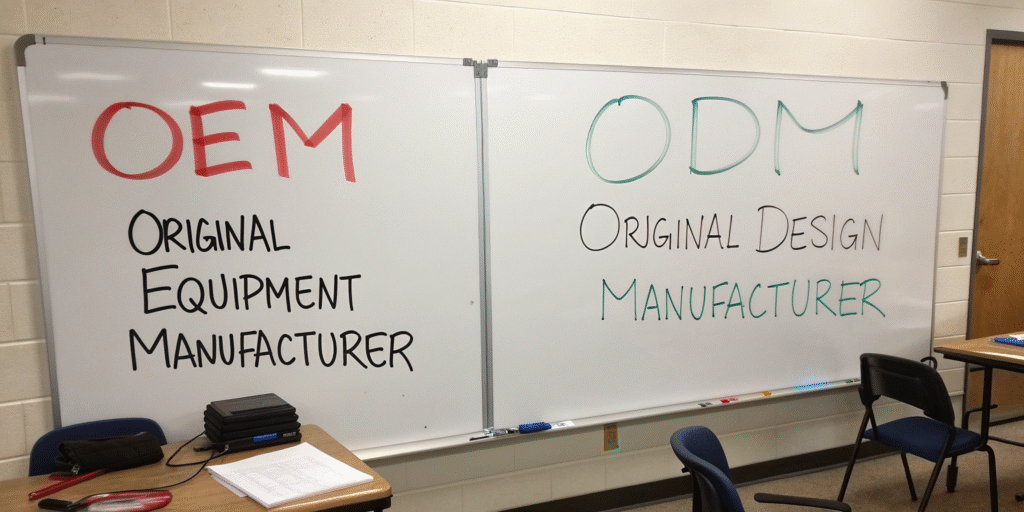
In the world of manufacturing and product development, the terms OEM (Original Equipment Manufacturer) and ODM (Original Design Manufacturer)[^1] are commonly used. Both play an essential role in the supply chain[^2], but they differ significantly in their responsibilities, processes, and business models. Understanding these terms and their implications is crucial for companies looking to outsource product development or manufacturing.
OEM (Original Equipment Manufacturer) makes products to a buyer's specs. ODM (Original Design Manufacturer)[^1] designs and makes products the buyer can brand and sell. Choose OEM for control, ODM for speed.
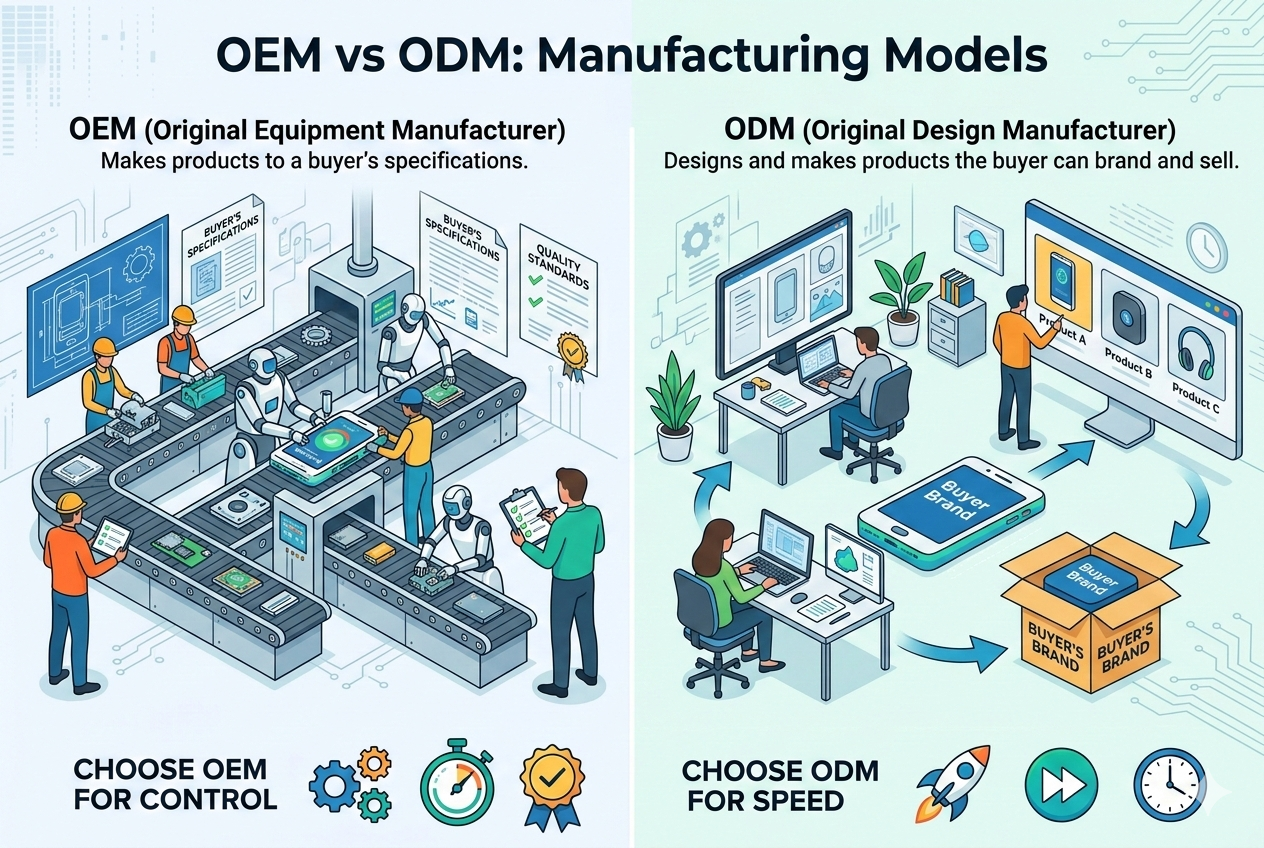
In this article, we’ll explain what OEM and ODM mean, when to use each, how they affect costs and timelines, and how to choose the right partner for your business needs.
What does OEM mean and when should I use it?
I wanted a supplier to build my exact design.
OEM means a factory manufactures products strictly to your design and specifications. You own the design and control production details.
I used OEM when I had proven designs and wanted consistent, branded units. OEM is best when you need full control over components, certifications[^3], and IP protection.
OEM benefits, drawbacks, and practical steps OEM gives you design ownership and production control. You provide drawings, BOM (bill of materials), and QA standards. The factory follows your documents and tooling. Benefits include exact specification control, easier certification management, and long-term product consistency. OEM also helps protect your intellectual property[^4] when you keep design files private and use contracts and NDAs. Drawbacks include higher upfront costs for tooling, longer lead times[^5] for new molds, and the need for stronger in-house engineering or external design resources. For buyers, OEM works well when you want unique features, proprietary components, or custom firmware. Practical steps: prepare detailed specifications, prototype and test thoroughly, negotiate MOQ and tooling costs, request process capability data, and include quality checkpoints like pre-production samples, production samples, and AQL inspections. Ask for certification documents and audit the supplier. For FUMEI, we offer OEM services with clear communication, sample testing, and support for certifications[^3] to help buyers scale safely.
What does ODM mean and when should I use it?
I needed a fast product launch with lower development cost.
ODM means the supplier designs and manufactures the product. You buy the finished item and rebrand it. ODM reduces development time but limits customization[^6].
I picked an ODM for my first line because I lacked design resources. The ODM provided tested designs and lowered initial costs. Later I upgraded features through OEM partners.
ODM advantages, limits, and how to work with ODMs ODM speeds up market entry[^7] by offering existing designs you can brand. The supplier handles R&D, testing, and initial certifications[^3]. Advantages include lower upfront investment, reduced technical risk, and faster time to market. Many ODMs already have proven supply chain[^2]s and tooling. Limits are reduced product uniqueness, potential overlap with other buyers using the same design, and sometimes weaker IP protection. Customization is often limited to branding, color, minor firmware tweaks, or accessory bundles. To work well with ODMs, evaluate their design library and request technical datasheets. Ask for performance test reports and sample units. Negotiate exclusivity if you need unique differentiation. Check certifications[^3] and supply chain[^2] transparency. For buyers planning to scale or enter competitive markets, use ODM for validation and move to OEM for differentiated products later.
How do OEM and ODM affect cost, time, and risk?
I compared quotes from OEM and ODM factories.
ODM usually lowers cost and time but raises product similarity risk. OEM raises control and IP protection but needs more time and money upfront.
I balanced speed and uniqueness by starting with ODM for a basic SKU and switching to OEM for a premium line. That strategy minimized early risk while protecting long-term value.
a clear comparison table and decision points Use this table to compare key factors:
| Factor | OEM | ODM |
|---|---|---|
| Design control | High | Low |
| Upfront cost | High (tooling, engineering) | Low |
| Time to market | Longer | Shorter |
| Customization | Full | Limited |
| IP protection | Stronger (you own designs) | Weaker unless negotiated |
| MOQ | Often higher | Often lower |
| Certification handling | Buyer-driven | Supplier may provide |
Decide based on your business stage. If you have unique tech or need exclusivity, choose OEM despite higher cost and time. If you need a quick product to test the market, ODM is practical. In procurement, always request prototypes, test reports, and supplier references. Negotiate clear contracts for warranty, defect rates, and lead times[^5]. Keep an eye on certificate authenticity, especially for electronics. At FUMEI, we offer both OEM and ODM services for chargers and cables. We help with sample testing, certifications[^3], and small-batch runs so buyers can scale with low risk.
How to pick the right partner for OEM or ODM?
I interviewed several factories before deciding.
Pick partners with proven experience, clear communication, test reports, and reliable QC processes. Visit the factory if possible or hire third-party audits[^8].
I prioritized suppliers who shared process photos, sample test data, and a clear roadmap for scale. That reduced surprises later.
checklist for vetting suppliers and negotiating terms Use this checklist when choosing a partner. 1) Verify company background and years in business. 2) Ask for case studies and references in your product category. 3) Request sample units and full test reports (electrical, safety, EMC). 4) Confirm certifications[^3] and ask for original certificates. 5) Evaluate communication: response time, clarity, and language. 6) Inspect production capacity, lead times[^5], and MOQ. 7) Review quality control[^9]: in-line checks, AQL, and final inspection reports. 8) Negotiate payment terms, warranty, and defect handling. 9) Consider third-party inspections or factory audits for critical orders. 10) Protect IP with NDAs and clear contract clauses. For electronics like chargers, insist on safety marks[^10] and lab testing. FUMEI supports buyers with documentation, sample testing, and factory transparency to build trust.
Conclusion
Understanding OEM and ODM is essential for any business looking to source products efficiently.
OEM is best for companies that have a clear design in mind and need help with manufacturing.
ODM is ideal for businesses looking for a complete solution, from design to manufacturing.
By carefully considering costs, timelines, risk, and choosing the right partner, you can avoid common pitfalls and ensure a successful manufacturing partnership.
[^1]: Learn about ODM and its role in product development, which can help you make informed outsourcing decisions. [^2]: Understanding the supply chain is crucial for optimizing your manufacturing processes and partnerships. [^3]: Explore essential certifications that can enhance your product's credibility and marketability. [^4]: This resource will provide insights on safeguarding your designs and innovations in the manufacturing sector. [^5]: Understanding lead times can help you plan better and meet market demands efficiently. [^6]: Explore ways to customize products effectively, enhancing your brand's uniqueness in the market. [^7]: Explore strategies for successful market entry, crucial for launching new products effectively. [^8]: Learn how third-party audits can ensure compliance and quality in your manufacturing processes. [^9]: Discover effective quality control strategies to maintain high standards in your manufacturing processes. [^10]: Understanding safety marks is vital for ensuring your products meet regulatory standards and consumer safety.