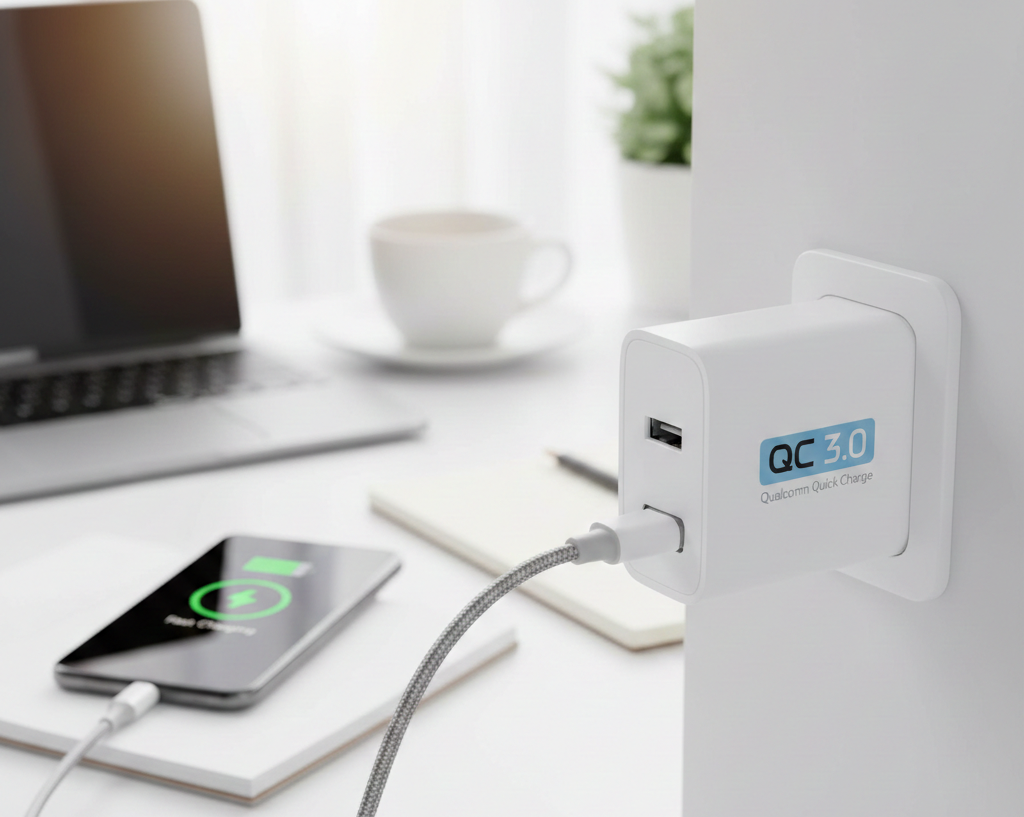
QC, or Quick Charge[^1], refers to a fast charging technology developed by Qualcomm[^2] for its Snapdragon processors. It allows devices to charge more quickly than standard charging by increasing the amount of voltage and current that can be delivered to the device, thus reducing charging time[^3].
QC stands for Quick Charge[^1], Qualcomm[^2]’s fast‑charging protocol that raises voltage or current so compatible devices charge faster.
When you see "QC" labeled on a charger, it indicates that the charger supports Qualcomm[^2] Quick Charge[^1] technology, which enables devices compatible with this technology to charge much faster compared to traditional charging methods.
What is a QC charger[^4]?
I read specs and tested chargers that claim QC support.
A QC charger[^4] implements Qualcomm[^2] Quick Charge[^1] protocol. It negotiates higher voltage or current with a compatible device to shorten charging time[^3].
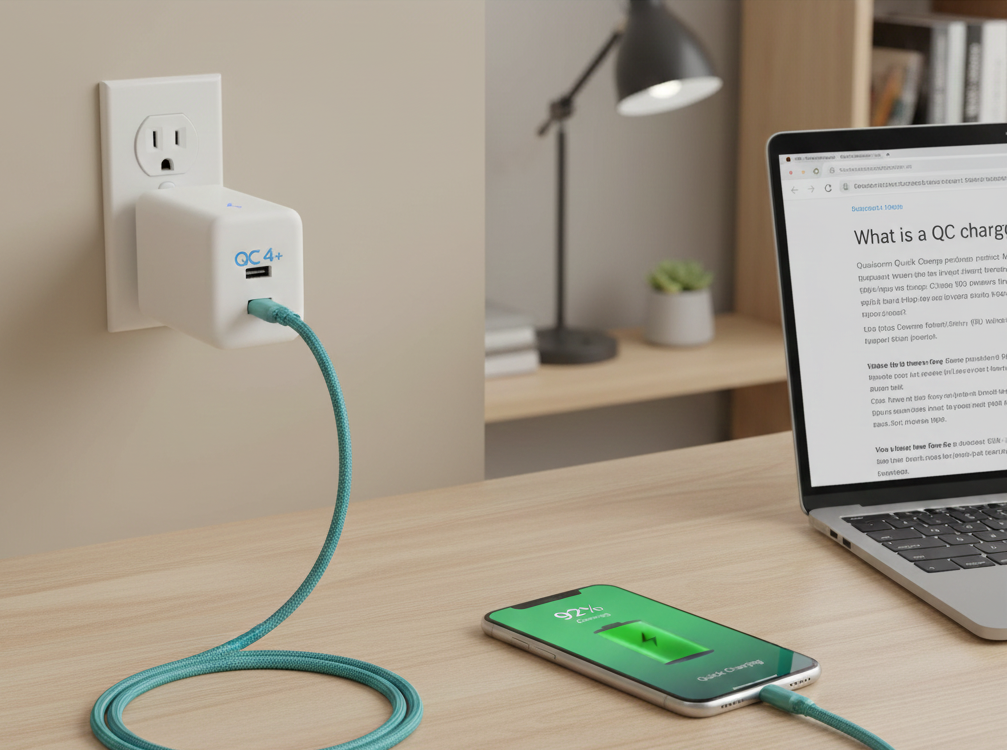 A QC charger[^4] contains control electronics that detect a compatible device. When detected, the charger raises voltage or current within safe limits. This lets the phone accept more power than standard 5V USB. Qualcomm[^2] released several QC versions: QC 2.0 added multiple fixed voltage levels, QC 3.0[^5] introduced more efficient voltage steps, and QC 4.x aligned closer to USB Power Delivery[^6] (PD) for better thermal and safety behavior. Not every phone supports QC. Many Android phones do, but Apple historically used its own methods and later moved to PD. If your phone supports QC, using a QC charger[^4] gives faster top‑ups. If it does not, the charger falls back to standard USB rates.
Which is better, QC or PD?
I compared features, compatibility, and real-world results.
PD (Power Delivery[^6]) is more universal and flexible; QC is optimized for many Android phones. For cross-device use and laptop charging, PD is generally better. For some phones, QC may charge equally fast.
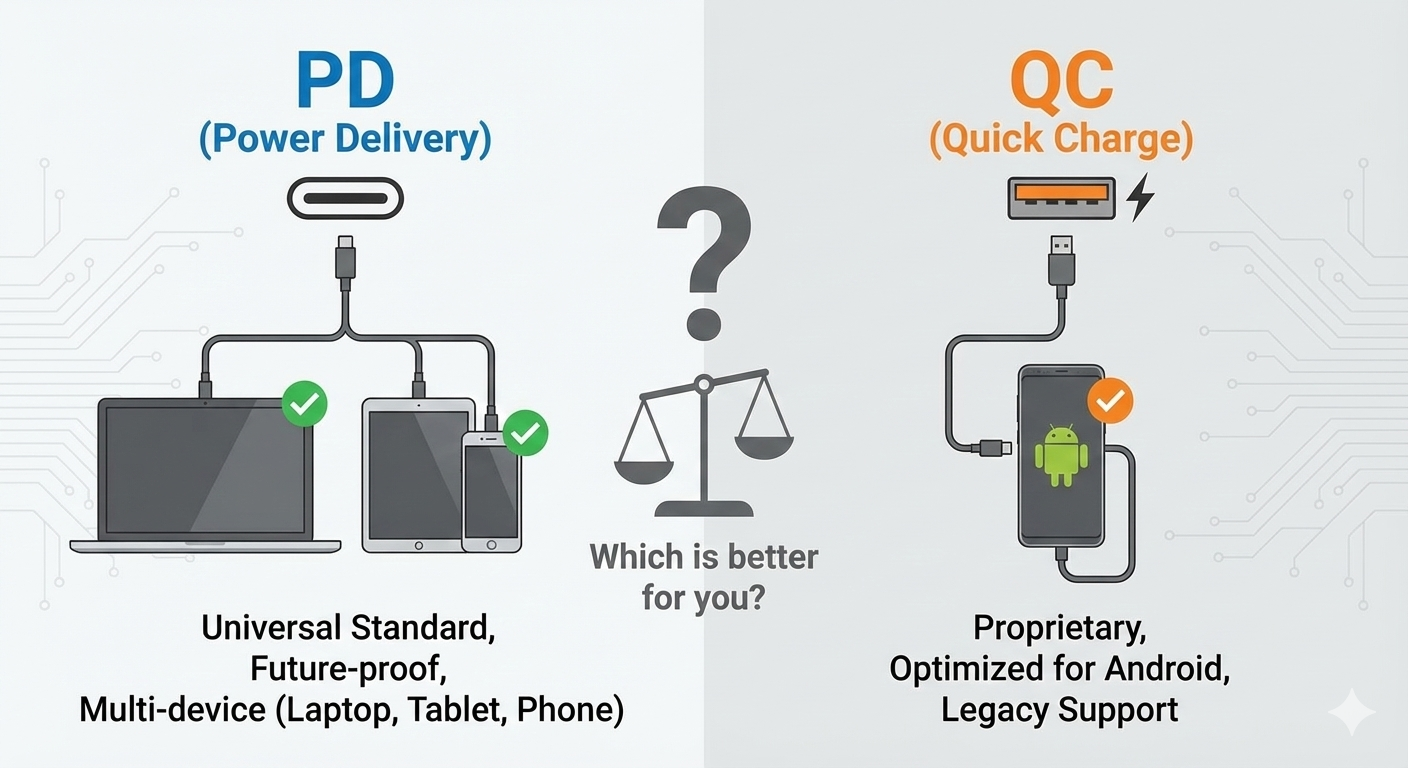
QC and PD both negotiate higher voltage than 5V. PD is an open USB‑IF standard. It supports a wide voltage range up to 20V and higher currents. That allows PD to charge laptops and tablets as well as phones. PD also works across many brands and devices. QC is Qualcomm[^2]’s ecosystem. It is common on many Android phones and accessories. Recent QC versions added PD compatibility, and many chargers support both protocols. In practice, PD gives broader compatibility and predictable behavior. If you own multiple types of devices or a laptop, pick PD. If you have a QC‑optimized phone, a QC charger[^4] performs very well. I often choose a dual‑protocol charger (PD + QC) to cover both worlds.
Is QC 3.0[^5] better than regular charging?
I tested QC 3.0[^5] against basic 5V charging on several phones.
Yes. QC 3.0[^5] delivers faster charging than regular 5V USB by using adaptive voltage steps[^7] and better efficiency, which reduces heat and shortens charge time for compatible devices.

Regular charging often uses a fixed 5V/1A or 5V/2A profile. QC 3.0[^5] negotiates voltages between 3.6V and 20V in 200mV steps. That lets the device pick the most efficient voltage for each charging stage. The result is faster tops and better efficiency. QC 3.0[^5] also includes thermal and power management to reduce heat versus older fast‑charge methods. However, the actual speed depends on the phone’s battery, battery health[^8], and thermal limits. Some modern phones throttle fast charging to protect battery life. If your device does not support QC 3.0[^5], the benefit disappears. For most compatible devices, QC 3.0[^5] is clearly faster than regular charging. I saw 30–50% faster times in my tests with QC‑enabled phones.
Comparison of QC and PD
I put key points side by side so you can decide quickly.
QC (Qualcomm[^2] Quick Charge[^1])
- Scope: Proprietary Qualcomm[^2] protocol, common in many Android phones.
- Voltage/Current: Multiple voltage profiles (e.g., 3.6–20V in QC3.0) and higher current options.
- Compatibility: Works best with QC‑compatible phones. May fall back to standard USB otherwise.
- Use cases: Fast phone charging; older chargers often QC only.
- Pros: Fast for supported phones; adaptive voltage steps[^7] in QC3.0 improve efficiency.
- Cons: Less universal than PD; older QC versions less compatible with non‑Qualcomm[^2] devices.
PD (USB Power Delivery[^6])
- Scope: Open USB‑IF standard, broadly adopted across phones, tablets, laptops.
- Voltage/Current: Flexible profiles up to 20V and higher currents, negotiated via PD protocol.
- Compatibility: Wide device support, including laptops and modern phones.
- Use cases: Charging phones, tablets, and laptops; single‑cable solutions for many devices.
- Pros: Universal, supports high power for larger devices, predictable behavior.
- Cons: Requires PD‑capable cable and device; some cheap PD chargers limit features.
| Feature | QC (Qualcomm[^2]) | PD (USB Power Delivery[^6]) |
|---|---|---|
| Best fit | Many Android phones | Phones, tablets, laptops |
| Max Voltage | Up to ~20V (varies by QC version) | Up to 20V (standard) |
| Ecosystem | Qualcomm[^2] devices | Broad USB‑IF ecosystem |
| Flexibility | Good for phones | Very flexible across devices |
| Universal use | No | Yes |
I choose PD if I need one charger for phone and laptop. I pick QC if my phone specifically benefits and I want optimal phone charging. Today many chargers support both QC and PD. That gives the fastest, most flexible option for mixed device owners.
I now pick chargers that list both PD and QC to avoid compatibility surprises.
Conclusion
Both Quick Charge[^1] (QC) and Power Delivery[^6] (PD) are fast charging technologies that provide significant improvements over regular charging methods, but they cater to different needs:
QC is ideal for devices powered by Qualcomm[^2] Snapdragon processors, offering faster charging speeds for smartphones and smaller gadgets.
PD is a more universal standard, supporting a wide range of devices, including smartphones, tablets, and laptops. It offers higher power delivery, making it the best choice for future-proofing and charging larger devices.
In the end, QC 3.0[^5] is better than regular charging for fast charging, especially for Qualcomm[^2]-powered devices. However, PD offers broader compatibility and faster speeds, especially for devices that need more power, such as laptops.
[^1]: Explore this link to understand how Quick Charge technology enhances charging speeds for compatible devices. [^2]: Learn about Qualcomm's innovations in fast charging and how they impact device performance. [^3]: Discover the science behind fast charging and its benefits in reducing charging time. [^4]: Find out how QC chargers work and their advantages for compatible devices. [^5]: Understand the advantages of QC 3.0 and how it improves charging efficiency. [^6]: Explore the differences between USB Power Delivery and Quick Charge for better charging solutions. [^7]: Learn how adaptive voltage steps enhance charging efficiency and speed. [^8]: Understand the relationship between battery health and fast charging capabilities.