I once swapped my slow adapter for a 45W charger and noticed real speed gains.
A 45W USB-C charger can be fast for many devices. Speed depends on device limits, cable quality, and charging protocol negotiation.
Which is better, a 45W or 25W charger?
I tried both and found each has a place.
45W is better for laptops, tablets, and multi-device use.[^1] 25W is fine for phones and saves cost and heat. Choose based on your devices and use cases.
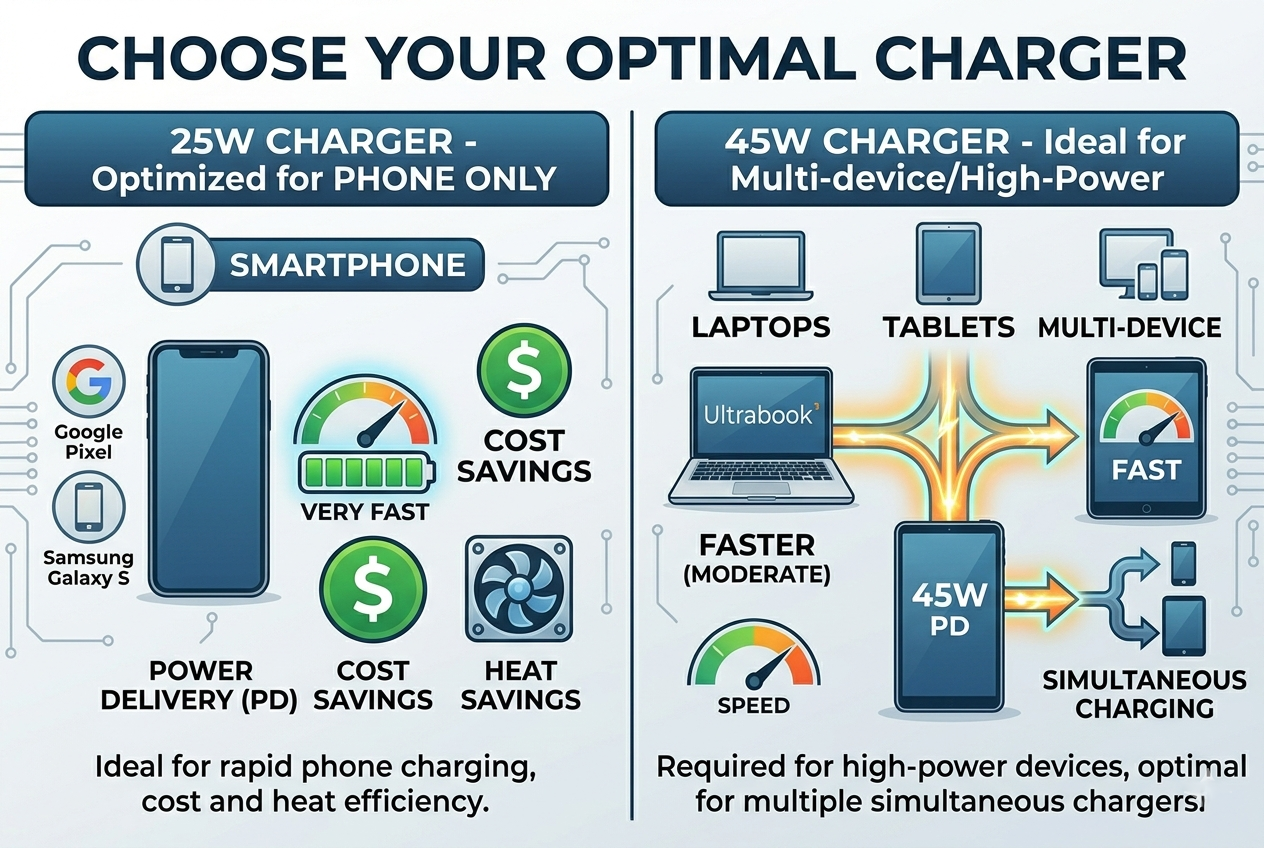
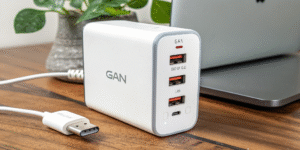
I keep a 45W GaN charger for travel and a 25W for overnight phone charging.
45W gives higher headroom. It can charge a phone fast and also top up a laptop or larger tablet. For example, many ultrabooks and some Chromebooks accept 45W or higher via USB-C PD.[^2] In that case, a 45W charger replaces a bulky laptop brick. A 25W charger works well for most phones, and some phones reach peak charging near 25W. It wastes less energy as heat when the phone limits draw. For pure phone use, 25W can be nearly as fast as higher-watt chargers if the phone’s peak draw is close to that number. If you own a mix of devices, a single 45W charger is more flexible. If you only charge phones and want a lower-cost option, 25W is fine. Also consider heat and battery care. Higher wattage can raise charging temperatures when devices draw at peak.[^3] Over time, higher heat can affect battery lifespan.[^4] So if you often charge overnight, a lower-watt charger may be gentler on the battery.
Is a 45W charger a fast charger?
I tested different chargers and saw faster top-ups with higher wattage—but with limits.
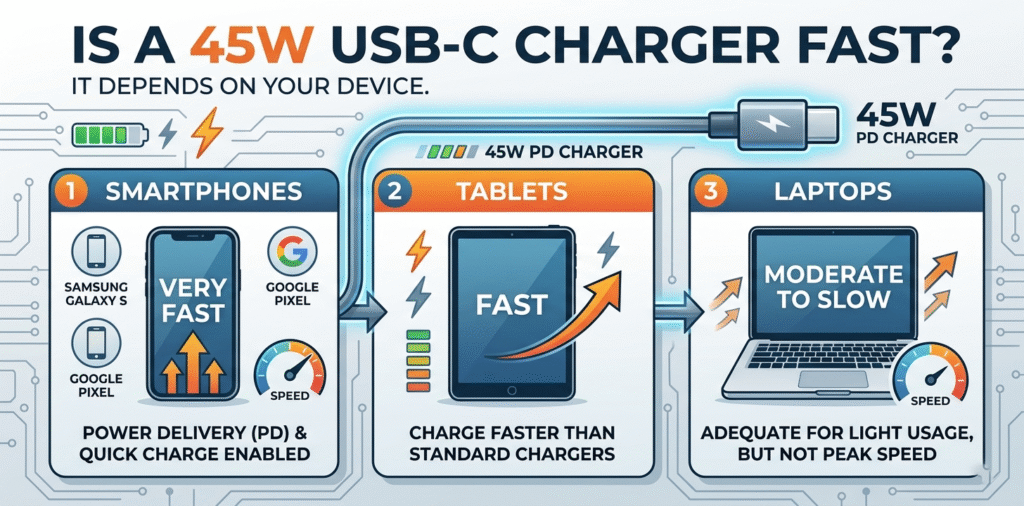
Yes, 45W counts as a fast charger when the device supports higher input. But phones often cap draw, so the actual speed boost varies.
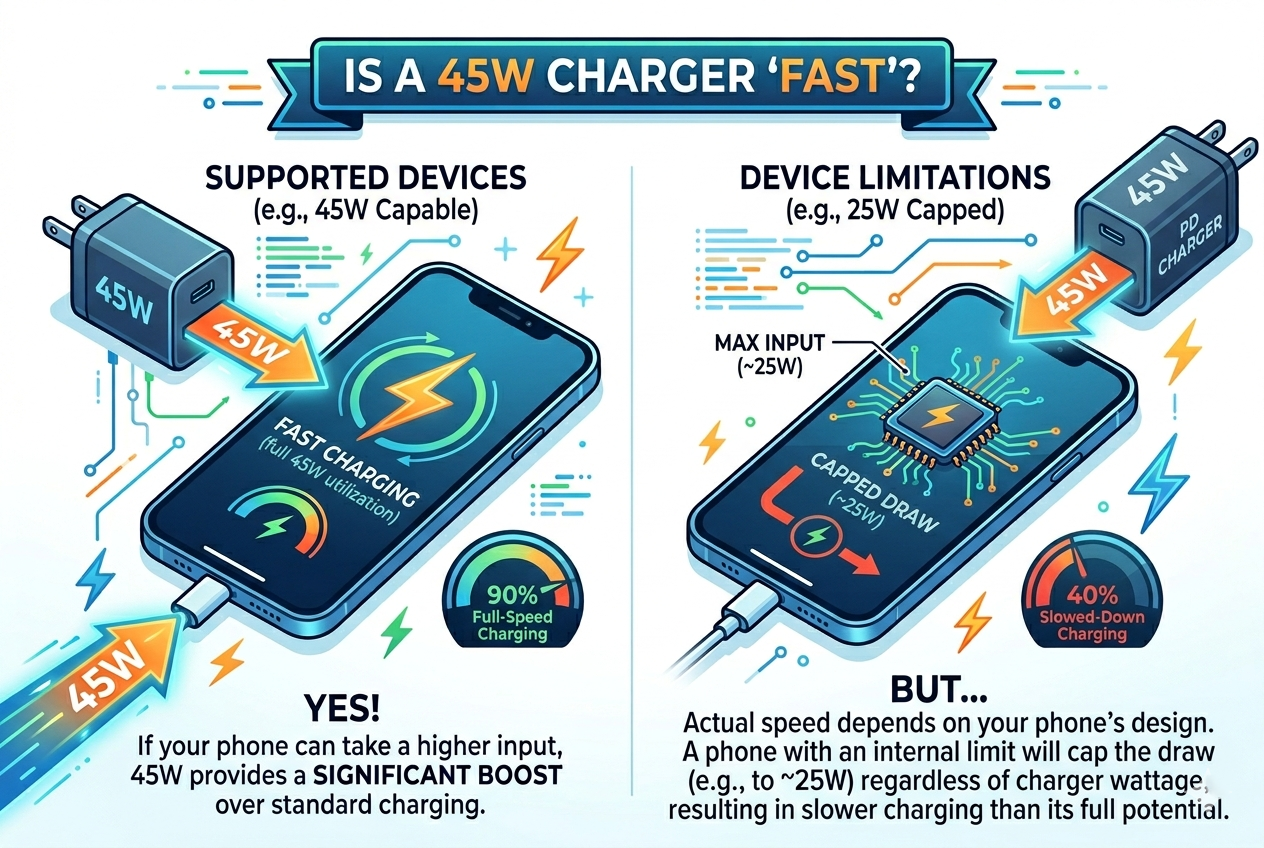
I saw quicker 0–50% times, then tapering as the battery neared full.
A charger is “fast” when it shortens the time to reach a useful battery level. For many phones, the biggest gains occur from 0% to about 50–80%. A 45W PD or PPS charger helps reach that window faster if the phone negotiates higher voltage and current. But many phones limit peak wired input to somewhere between 18W and 30W. In those cases, the phone will not draw 45W. The extra headroom is useful for other devices, though. For laptops and tablets designed for higher wattage, 45W can provide true fast charging. Also, PPS (Programmable Power Supply) support matters. PPS lets charger and device fine-tune voltage and current and reduces heat.[^5] A 45W charger with PPS can be more efficient and cooler than a non-PPS charger at the same wattage. In short, 45W is objectively high power. Whether it acts as “fast charging” depends on device capability and charging protocol support.
Can all USB-C cables handle 45W?
I once used a cheap cable that felt warm and learned to check cable ratings.
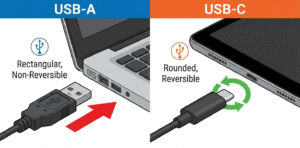
No. Not all USB-C cables support 45W.[^6] You must use cables rated for the current and USB PD/PPS features. Look for quality, certification, and proper power rating.
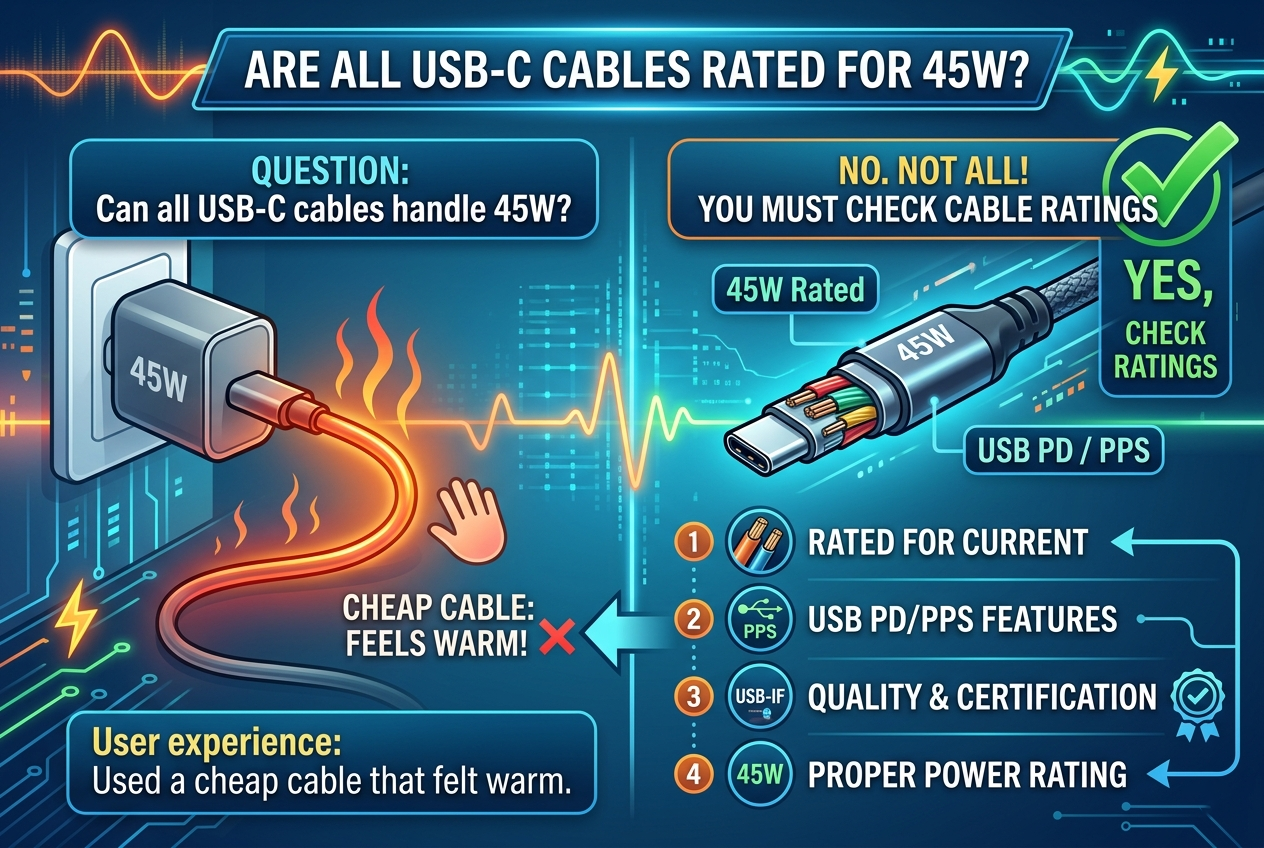
I now keep a few certified cables rated for high wattage and avoid unknown cheap cables.
Cables have different power ratings. Basic USB-C cables may only support USB 2.0 speeds and carry limited current.[^7] For 45W at 9V/5A style power, the cable must support higher current, often up to 5A. Good cables list their current rating (e.g., 3A or 5A) and often comply with USB-IF or another certification. There are two common cable types to watch for: standard USB-C cables that support up to 3A and enhanced cables that support up to 5A. A 45W PD profile often runs at higher voltage rather than extreme current. Still, the cable must be robust. Use cables with e-marker chips for 5A cables.[^8] The e-marker signals the host and charger that the cable is safe for higher currents. Cheap or unbranded cables without e-markers can misreport capacity and risk heat or damage. Also watch connector quality and shielding for data speeds. If you rely on high data rates or alt-mode video, choose a cable rated for USB 3.2 or USB4 as needed. Finally, short cables often handle heat better and lose less voltage. A high-quality short 5A cable is safer and more efficient for 45W charging than a long cheap one.
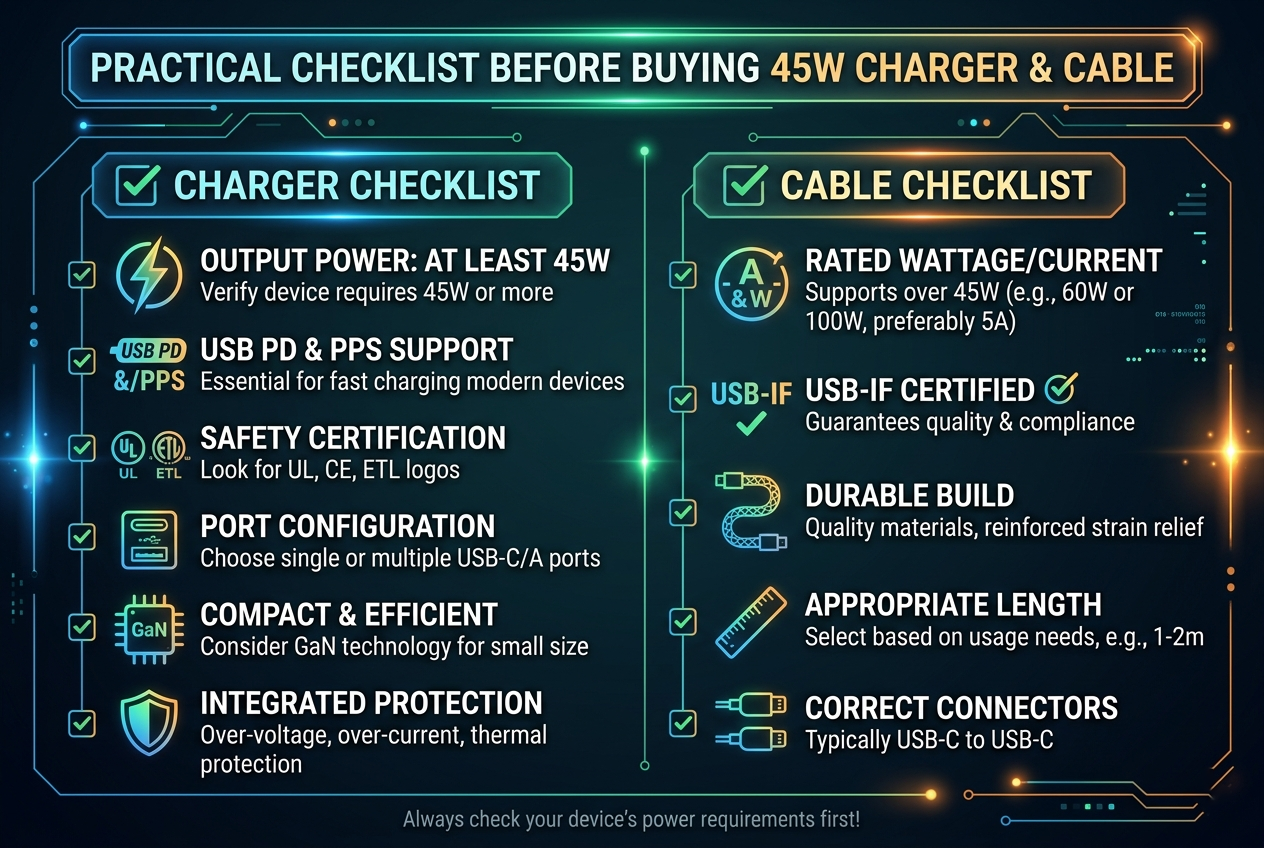
Practical checklist before buying a 45W charger or cable
I keep a short checklist to avoid bad purchases.
- Check device max input. If device tops at 20–30W, 45W adds little speed.
- Use PD or PPS-capable chargers to ensure proper negotiation.
- Buy cables rated for 3A or 5A as needed. Prefer cables with e-marker chips for high current.
- Choose reputable brands and look for USB-IF, UL, CE, or other safety marks.
- For laptops, confirm the charger provides required wattage and correct PD profiles.
- Prefer GaN chargers for small size and better thermal performance.
- Read user reviews for real-world heat and reliability feedback.
Conclusion
A 45W USB-C charger is fast for devices that can use higher power.[^9] Match charger, cable, and device for best results.
[^1]: "Is 45W Enough? How to Choose the Right Wattage for Daily Charging", https://www.anker.com/blogs/chargers/is-45w-enough-for-daily-charging. This source explains the advantages of using a 45W charger for laptops, tablets, and multi-device scenarios, emphasizing its compatibility with higher power requirements. Evidence role: general_support; source type: education. Supports: 45W chargers are more suitable for laptops, tablets, and multi-device use due to their higher power output.. [^2]: "USB C is a freaking mess. 45 W charger only does Super ... - Reddit", https://www.reddit.com/r/GalaxyS22/comments/t2eufz/usb_c_is_a_freaking_mess_45_w_charger_only_does/. This source confirms that many ultrabooks and Chromebooks support 45W or higher charging through USB-C Power Delivery. Evidence role: general_support; source type: education. Supports: Many ultrabooks and Chromebooks are compatible with 45W or higher USB-C PD chargers.. [^3]: "Processor power dissipation - Wikipedia", https://en.wikipedia.org/wiki/Processor_power_dissipation. This source discusses the relationship between higher wattage charging and increased device temperatures during peak power draw. Evidence role: mechanism; source type: research. Supports: Higher wattage charging can lead to increased temperatures when devices draw power at their peak capacity.. [^4]: "Heat Generation and Degradation Mechanism of Lithium-Ion ... - PMC", https://pmc.ncbi.nlm.nih.gov/articles/PMC9753165/. This source explains how prolonged exposure to higher temperatures during charging can degrade battery lifespan over time. Evidence role: mechanism; source type: research. Supports: Higher heat during charging can negatively impact battery lifespan over extended periods.. [^5]: "[PDF] Pulsed Power Engineering Basic Topologies", https://uspas.fnal.gov/materials/09VU/PPE_BasicTopologies.pdf. This source describes how PPS technology enables fine-tuning of voltage and current, leading to reduced heat during charging. Evidence role: mechanism; source type: research. Supports: PPS technology allows for optimized voltage and current adjustments, which can reduce heat during charging.. [^6]: "45 Watt Type C Fast Charging Android Phone Charger Compatible ...", https://www.amazon.com/Samsung-Charger-Charging-Android-Galaxy/dp/B0C2HK3VYP. This source confirms that not all USB-C cables are rated to handle 45W power, emphasizing the need for proper certification and ratings. Evidence role: general_support; source type: education. Supports: Not all USB-C cables are capable of supporting 45W charging due to varying power ratings and certifications.. [^7]: "USB-C - Wikipedia", https://en.wikipedia.org/wiki/USB-C. This source explains that basic USB-C cables are often limited to USB 2.0 speeds and lower current capacities. Evidence role: definition; source type: education. Supports: Basic USB-C cables typically support only USB 2.0 speeds and limited current capacities.. [^8]: "What is an E-Marker in a USB Type-C Cable and How Does It Work?", https://www.totalphase.com/blog/2020/10/what-is-e-marker-how-does-it-work/?srsltid=AfmBOorNHmAjqiWTC4LeBHndhoPWX34Zcza0rRuBI2g4H6C7krgdIwJk. This source highlights the importance of e-marker chips in USB-C cables for safely handling 5A current. Evidence role: mechanism; source type: education. Supports: E-marker chips in USB-C cables are essential for safely supporting 5A current.. [^9]: "High-Efficiency 45W USB-C Charger: How GaN Technology ... - Anker", https://www.anker.com/blogs/chargers/high-efficiency-45w-usb-c-charger. This source supports the claim that 45W USB-C chargers provide fast charging for devices capable of utilizing higher power inputs. Evidence role: general_support; source type: education. Supports: 45W USB-C chargers are effective for fast charging when devices support higher power inputs.. Scope note: The speed benefit applies only to devices designed to handle 45W input.